Suffix Automaton Algorithm
Suffix Automaton (DAWG)
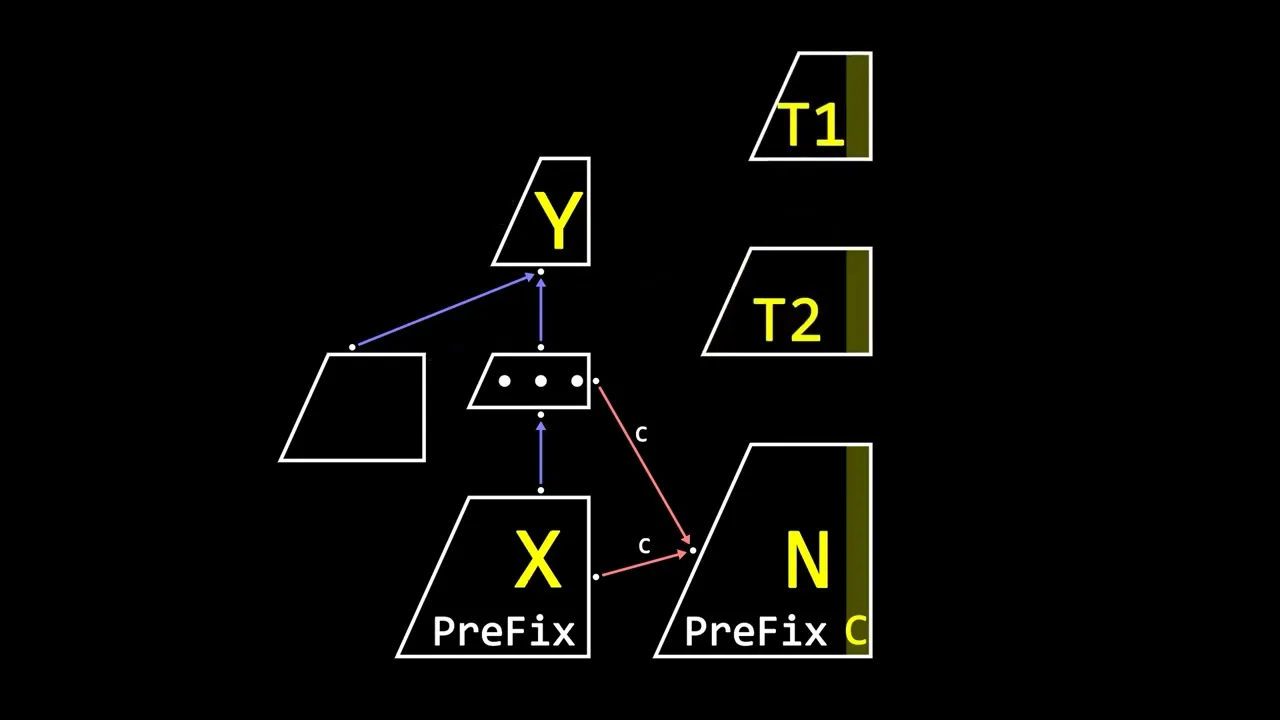
A Suffix Automaton is a powerful directed acyclic word graph representing all suffixes of a given string in linear time and space.
Video Explanation
Complexity
- Construction Time: O(N)
- Space Complexity: O(N)
Implementation (Python)
class SuffixAutomaton:
    class State:
        def __init__(self, length=0, link=-1):
            self.len = length
            self.link = link
            self.next = {}

    def __init__(self, s=""):
        self.st = [self.State(0, -1)]
        self.sz = 1
        self.last = 0
        for char in s:
            self.extend(char)

    def extend(self, char):
        cur = self.sz
        self.sz += 1
        self.st.append(self.State(self.st[self.last].len + 1))

        p = self.last
        while p != -1 and char not in self.st[p].next:
            self.st[p].next[char] = cur
            p = self.st[p].link

        if p == -1:
            self.st[cur].link = 0
        else:
            q = self.st[p].next[char]
            if self.st[p].len + 1 == self.st[q].len:
                self.st[cur].link = q
            else:
                clone = self.sz
                self.sz += 1
                self.st.append(self.State(self.st[p].len + 1, self.st[q].link))
                self.st[clone].next = self.st[q].next.copy()

                while p != -1 and self.st[p].next.get(char) == q:
                    self.st[p].next[char] = clone
                    p = self.st[p].link

                self.st[q].link = self.st[cur].link = clone
        self.last = cur

    def contains(self, pattern):
        curr = 0
        for char in pattern:
            if char not in self.st[curr].next:
                return False
            curr = self.st[curr].next[char]
        return True

# Example usage:
# sa = SuffixAutomaton("abbb")
# print(sa.contains("bb")) # True
# print(sa.contains("aba")) # False
🧠 Quick Quiz
Test Your Understanding
Answer these 3 questions to check what you have learned.
Q1
What is the main topic of this documentation page?
Q2
What should be identified before implementing suffix automaton?
Q3
How is understanding of suffix automaton best checked?
Track Your Progress
Done with this topic? Mark it as complete to track your progress.
Was this page helpful?
💬
Discuss this page
Have a question or spot something confusing in "Suffix Automaton Algorithm"? Ask below. Backed by GitHub Discussions—maintainers receive system notifications directly.