Bellman-Ford Algorithm
Definition:
The Bellman-Ford Algorithm is a graph algorithm used to find the shortest paths from a single source vertex to all other vertices in a weighted directed graph. Unlike Dijkstra's Algorithm, it can handle graphs with negative edge weights and is also capable of detecting negative weight cycles.
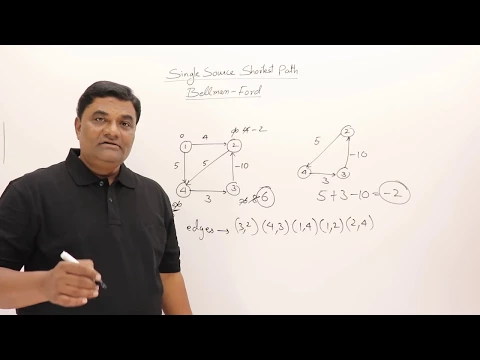
Video Explanation
Characteristics:
- Edge Relaxation Based:
The algorithm repeatedly relaxes all edges up to
V - 1times (whereVis the number of vertices), progressively finding shorter paths. - Handles Negative Weights: Works correctly on graphs with negative edge weights, which Dijkstra's Algorithm cannot handle.
- Negative Cycle Detection:
After
V - 1iterations, if any edge can still be relaxed, a negative weight cycle exists in the graph. - Dynamic Programming Approach: Builds up shortest path estimates step by step, ensuring correctness after each round of relaxation.
Time Complexity:
- Best Case: O(E)
When an early-termination optimization is applied and no relaxation occurs after the very first pass — meaning all edges are already in shortest-path order. The algorithm exits after a single round over all
Eedges. - Average Case: O(VE)
In practice, several rounds of relaxation are needed before distances stabilize. The algorithm performs roughly
kpasses (wherek < V - 1) over allEedges before no updates are found. - Worst Case: O(VE)
When the shortest path to the farthest vertex requires all
V - 1relaxation rounds — for example, in a linear chain graph where the source is at one end. HereVis the number of vertices andEis the number of edges.
Space Complexity:
- Space Complexity: O(V)
Only a distance array of size
Vis needed to store the shortest path estimates.
Approach:
The algorithm follows these steps:
-
Initialization:
- Set the distance to the source vertex as
0. - Set the distance to all other vertices as
infinity (INF).
- Set the distance to the source vertex as
-
Relaxation (V - 1 iterations):
- For each edge
(u, v, w), ifdistance[u] + w < distance[v], updatedistance[v] = distance[u] + w. - Repeat this for all edges,
V - 1times.
- For each edge
-
Negative Cycle Detection:
- After
V - 1iterations, perform one more pass over all edges. - If any distance can still be reduced, the graph contains a negative weight cycle.
- After
-
Output:
- The
distance[]array holds the shortest distance from the source to every other vertex.
- The
Dry Run Example
Consider the following graph:
Source Vertex: A
Note: For this dry run, we assume the edges are relaxed in the following order: (A, B), (A, C), (C, B), (B, D), (C, E), (D, E).
Initial Distances
| Vertex | Distance |
|---|---|
| A | 0 |
| B | ∞ |
| C | ∞ |
| D | ∞ |
| E | ∞ |
After Pass 1
| Vertex | Distance |
|---|---|
| A | 0 |
| B | 1 |
| C | 2 |
| D | 3 |
| E | 5 |
After Pass 2
No further updates occur.
Final Shortest Distances
| Vertex | Distance |
|---|---|
| A | 0 |
| B | 1 |
| C | 2 |
| D | 3 |
| E | 5 |
The shortest path to B becomes:
A → C → B
with cost:
2 + (-1) = 1
This example demonstrates why Bellman-Ford is useful for graphs containing negative edge weights. The algorithm successfully finds a shorter path through a negative-weight edge, which standard Dijkstra's algorithm cannot handle correctly.
Visualization of Relaxation Process
Bellman-Ford works by repeatedly relaxing every edge in the graph. Each relaxation attempts to improve the currently known shortest distance to a vertex.
For every edge:
If distance[u] + weight < distance[v]

Then

distance[v] = distance[u] + weight
Relaxation Flow
Negative Cycle Detection
Cycle Weight:
-1 + (-2) + 1 = -2
Since the total cycle weight is negative, repeatedly traversing this cycle keeps reducing the path cost. Bellman-Ford detects this during the additional relaxation pass.
After performing V−1 iterations:
One more iteration is performed.
If any distance still decreases:
Graph contains a Negative Weight Cycle
Otherwise:
Shortest Paths Found Successfully
C++ Implementation:
#include <bits/stdc++.h>
using namespace std;

struct Edge {
    int u, v, w;
};

void bellmanFord(int src, int V, vector<Edge>& edges) {
    vector<int> dist(V, INT_MAX);
    dist[src] = 0;

    // Relax all edges V-1 times
    for (int i = 1; i <= V - 1; i++) {
        for (auto& edge : edges) {
            if (dist[edge.u] != INT_MAX && dist[edge.u] + edge.w < dist[edge.v]) {
                dist[edge.v] = dist[edge.u] + edge.w;
            }
        }
    }

    // Check for negative weight cycles
    for (auto& edge : edges) {
        if (dist[edge.u] != INT_MAX && dist[edge.u] + edge.w < dist[edge.v]) {
            cout << "Graph contains a negative weight cycle!" << endl;
            return;
        }
    }

    // Print shortest distances
    cout << "Vertex\tDistance from Source" << endl;
    for (int i = 0; i < V; i++) {
        cout << i << "\t" << dist[i] << endl;
    }
}

int main() {
    int V = 5;
    vector<Edge> edges = {
        {0, 1, -1}, {0, 2, 4},
        {1, 2, 3},  {1, 3, 2},
        {1, 4, 2},  {3, 2, 5},
        {3, 1, 1},  {4, 3, -3}
    };

    bellmanFord(0, V, edges);
    return 0;
}
Output
Vertex  Distance from Source
0       0
1       -1
2       2
3       -2
4       1
Java Implementation:
import java.util.*;

public class BellmanFord {

    static class Edge {
        int u, v, w;
        Edge(int u, int v, int w) {
            this.u = u;
            this.v = v;
            this.w = w;
        }
    }

    public static void bellmanFord(int src, int V, List<Edge> edges) {
        int[] dist = new int[V];
        Arrays.fill(dist, Integer.MAX_VALUE);
        dist[src] = 0;

        // Relax all edges V-1 times
        for (int i = 1; i <= V - 1; i++) {
            for (Edge edge : edges) {
                if (dist[edge.u] != Integer.MAX_VALUE && dist[edge.u] + edge.w < dist[edge.v]) {
                    dist[edge.v] = dist[edge.u] + edge.w;
                }
            }
        }

        // Check for negative weight cycles
        for (Edge edge : edges) {
            if (dist[edge.u] != Integer.MAX_VALUE && dist[edge.u] + edge.w < dist[edge.v]) {
                System.out.println("Graph contains a negative weight cycle!");
                return;
            }
        }

        // Print result
        System.out.println("Vertex\tDistance from Source");
        for (int i = 0; i < V; i++) {
            System.out.println(i + "\t" + dist[i]);
        }
    }

    public static void main(String[] args) {
        int V = 5;
        List<Edge> edges = Arrays.asList(
            new Edge(0, 1, -1), new Edge(0, 2, 4),
            new Edge(1, 2, 3),  new Edge(1, 3, 2),
            new Edge(1, 4, 2),  new Edge(3, 2, 5),
            new Edge(3, 1, 1),  new Edge(4, 3, -3)
        );

        bellmanFord(0, V, edges);
    }
}
Python Implementation:
def bellman_ford(src, V, edges):
    dist = [float('inf')] * V
    dist[src] = 0

    # Relax all edges V-1 times
    for _ in range(V - 1):
        for u, v, w in edges:
            if dist[u] != float('inf') and dist[u] + w < dist[v]:
                dist[v] = dist[u] + w

    # Check for negative weight cycles
    for u, v, w in edges:
        if dist[u] != float('inf') and dist[u] + w < dist[v]:
            print("Graph contains a negative weight cycle!")
            return

    print("Vertex\tDistance from Source")
    for i in range(V):
        print(f"{i}\t{dist[i]}")


if __name__ == "__main__":
    V = 5
    edges = [
        (0, 1, -1), (0, 2, 4),
        (1, 2, 3),  (1, 3, 2),
        (1, 4, 2),  (3, 2, 5),
        (3, 1, 1),  (4, 3, -3)
    ]
    bellman_ford(0, V, edges)
Complexity Analysis
Time Complexity
- Best Case: O(E) — early termination after a single pass when no relaxation is needed.
- Average Case: O(VE) — several passes are required before distances stabilize.
- Worst Case: O(VE) — all
V - 1rounds are needed (e.g., a linear chain graph). The outer loop runs up toV - 1times and the inner loop processes allEedges each iteration.
Space Complexity
- Space Complexity: O(V)
- Only the
dist[]array of sizeVis maintained.
Bellman-Ford vs Dijkstra's Algorithm
| Feature | Bellman-Ford | Dijkstra's |
|---|---|---|
| Negative edge weights | ✅ Supported | ❌ Not supported |
| Negative cycle detection | ✅ Yes | ❌ No |
| Time Complexity | O(VE) | O((V + E) log V) |
| Approach | Dynamic Programming | Greedy |
| Best used for | Sparse graphs with negative weights | Dense graphs with non-negative weights |
When to Use Bellman-Ford Algorithm
- Negative Edge Weights: When the graph contains edges with negative weights that would cause Dijkstra's Algorithm to fail.
- Negative Cycle Detection: When you need to verify whether a graph contains a negative weight cycle (common in arbitrage detection in financial systems).
- Network Routing: Used in distance-vector routing protocols like RIP (Routing Information Protocol).
- Single-Source Shortest Path: When you need shortest distances from one source to all other nodes.
Assumptions
- The graph is directed and may contain negative edge weights.
- The algorithm does not work correctly if a negative weight cycle is reachable from the source (it reports the cycle instead).
- If no negative cycle is present, the shortest path is guaranteed after
V - 1iterations.
Related Topics
- Dijkstra's Algorithm: Shortest path algorithm for non-negative weighted graphs ().
- Disjoint Set Union (DSU): Dynamic graph connectivity and component tracking ().
- Segment Tree: Dynamic range queries and updates ().
Conclusion
The Bellman-Ford Algorithm is a versatile and powerful shortest-path algorithm that extends beyond the limitations of Dijkstra's Algorithm by supporting negative edge weights and detecting negative cycles. While it is slower than Dijkstra's for graphs with non-negative weights, it is the go-to algorithm whenever negative weights or cycle detection are involved, making it indispensable in domains like network routing and financial graph analysis.
Test Your Understanding
Answer these 3 questions to check what you have learned.
What is the main topic of this documentation page?
What should be identified before implementing bellman ford algorithm?
How is understanding of bellman ford algorithm best checked?
Done with this topic? Mark it as complete to track your progress.
Was this page helpful?
Discuss this page
Have a question or spot something confusing in "Bellman-Ford Algorithm"? Ask below. Backed by GitHub Discussions—maintainers receive system notifications directly.