Recurrent Neural Networks (RNN)
Definition:
Recurrent Neural Networks (RNNs) are a class of artificial neural networks designed for modeling sequential data by introducing loops that allow information to persist across time steps. They are widely used for tasks like time-series forecasting, natural language processing (NLP), and speech recognition because of their ability to process and maintain information from previous inputs.
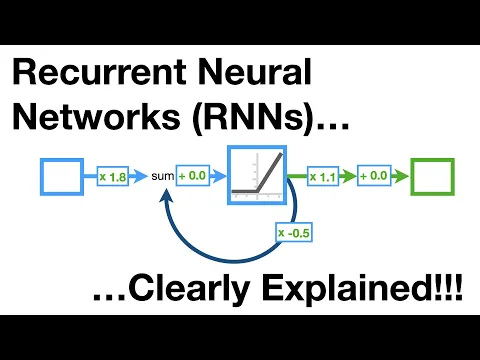
Video Explanation
Characteristics:
-
Sequential Data Handling:
RNNs excel at learning from and making predictions based on sequential data, where the order and context of the input are crucial. -
Shared Weights:
Unlike traditional neural networks, RNNs share the same parameters (weights) across different time steps, which allows them to process variable-length sequences without increasing the number of parameters. -
Memory:
RNNs have internal memory due to their recurrent connections, which allows them to store information about previous inputs and use it to influence future predictions.
Components of RNN:
-
Hidden State:
RNNs maintain a hidden state that captures information from previous time steps. At each time step, the hidden state is updated based on the current input and the previous hidden state. -
Recurrent Connection:
The recurrent connection is the key feature of RNNs. It enables information to flow from one time step to the next, creating a loop in the network's structure. -
Activation Function:
The hidden state is passed through an activation function, typically tanh or ReLU, to introduce non-linearity into the network and allow it to model complex patterns in sequential data. -
Output Layer:
The output at each time step is computed based on the current hidden state and can be used for predictions, classification, or further processing.
RNN Architecture:
-
Input Layer:
Sequential data, such as a series of time steps (e.g., words in a sentence or stock prices over time), is provided as input to the RNN. -
Recurrent Hidden Layer(s):
The hidden layer(s) process the input data one time step at a time, updating the hidden state based on both the current input and the previous hidden state. -
Output Layer:
Depending on the task, RNNs can produce output at each time step (e.g., for translation or generation tasks) or at the end of the sequence (e.g., for sentiment analysis or time-series prediction).
Types of RNNs:
-
Vanilla RNN:
The simplest form of RNN, where the hidden state is updated using the same weights at each time step. However, vanilla RNNs struggle with learning long-term dependencies due to the vanishing gradient problem. -
Long Short-Term Memory (LSTM):
LSTMs are a more advanced form of RNN designed to overcome the vanishing gradient problem. They use gates (input, forget, output) to control the flow of information and can learn long-term dependencies. -
Gated Recurrent Unit (GRU):
GRUs are a simplified version of LSTMs that combine the input and forget gates into a single update gate. GRUs are computationally cheaper while still addressing the vanishing gradient problem. -
Bidirectional RNN (BiRNN):
In a bidirectional RNN, two RNNs are run in parallel: one processes the sequence from left to right, and the other processes it from right to left. This architecture is useful for tasks where future context is as important as past context.
Problem Statement:
Given a sequential dataset (e.g., a sentence for language modeling or a time-series for prediction), the goal of an RNN is to predict the next element in the sequence or classify the entire sequence based on its content.
Key Concepts:
-
Sequential Processing:
RNNs process input sequences step by step, maintaining a hidden state that is updated at each step based on both the current input and previous hidden state. -
Vanishing Gradient Problem:
In vanilla RNNs, gradients may become very small (vanish) during backpropagation through time (BPTT), making it difficult to learn long-term dependencies. This is alleviated by architectures like LSTM and GRU. -
Backpropagation Through Time (BPTT):
RNNs use BPTT to train the network, where gradients are propagated backward through each time step in the sequence. -
Long-term Dependencies:
RNNs struggle with learning long-term dependencies (i.e., when the gap between relevant inputs and outputs is large), but LSTMs and GRUs address this challenge by incorporating gating mechanisms.
Steps Involved:
-
Input Data:
Sequential data, such as a series of time steps (e.g., stock prices, words in a sentence), is fed into the RNN one time step at a time. -
Hidden State Update:
At each time step, the hidden state is updated based on the current input and the previous hidden state, capturing information from earlier time steps. -
Output Generation:
The output can be generated at each time step or at the end of the sequence, depending on the task. In tasks like language modeling, the RNN predicts the next word at each step. -
Loss Calculation and Backpropagation:
The loss is calculated based on the predicted output and the true target. Backpropagation through time (BPTT) is used to update the weights. -
Final Prediction:
The RNN produces a final prediction, which could be a classification of the entire sequence (e.g., sentiment analysis) or a prediction for the next time step in the sequence (e.g., time-series forecasting).
Split Criteria:
RNNs handle sequential data where each input depends on the previous elements. The network processes the data one time step at a time, updating the hidden state with each new input.
Time Complexity:
-
Training Complexity:
The time complexity of training an RNN depends on the number of time steps , the size of the input , and the number of hidden units . It is roughly . -
Prediction Complexity:
For inference, the time complexity is also dependent on the sequence length, as each time step requires an update to the hidden state.
Space Complexity:
- Space Complexity:
The space complexity depends on the number of hidden units and time steps. Since RNNs store the hidden state at each time step, they require memory proportional to , where is the number of time steps and is the size of the hidden state.
Example:
Consider an example where we use an RNN to perform text generation:
import numpy as np
import tensorflow as tf
from tensorflow.keras import layers, models

# Sample training data (e.g., text sequence)
text = "hello world"
char_to_idx = {ch: idx for idx, ch in enumerate(set(text))}
idx_to_char = {idx: ch for ch, idx in char_to_idx.items()}
input_seq = [char_to_idx[ch] for ch in text]

# Prepare input data
input_seq = np.array(input_seq).reshape(1, -1)

# RNN Model
model = models.Sequential()

# Recurrent Layer (Simple RNN)
model.add(layers.SimpleRNN(50, input_shape=(None, len(char_to_idx)), return_sequences=True))
model.add(layers.Dense(len(char_to_idx), activation='softmax'))

# Compile model
model.compile(optimizer='adam', loss='categorical_crossentropy')

# Train the model (for illustration, usually longer training is needed)
model.fit(input_seq, input_seq, epochs=100)

# Predict the next character
prediction = model.predict(input_seq)
predicted_char = idx_to_char[np.argmax(prediction[0])]
print(f"Predicted next character: {predicted_char}")
Applications of RNNs:
-
Natural Language Processing (NLP):
RNNs are widely used in tasks like machine translation, text generation, sentiment analysis, and speech recognition due to their ability to model sequential dependencies in text and speech data. -
Time-series Forecasting:
RNNs can predict future values in time-series data by learning patterns from historical data, making them useful in finance, weather forecasting, and more. -
Speech Recognition:
RNNs are used to transcribe speech to text by processing sequential audio data and predicting the corresponding textual output. -
Sequence Generation:
RNNs can generate new sequences based on learned patterns, such as generating text, music, or even video frames. -
Handwriting Recognition:
RNNs can recognize handwritten text by processing sequential strokes or pixels in an image. -
Video Analysis:
RNNs are applied to video data to analyze sequences of frames, often combined with convolutional layers for extracting spatial features from each frame.
Advantages:
- Can process sequences of varying lengths.
- Maintain information from previous inputs, making them well-suited for sequential tasks.
- LSTMs and GRUs help overcome the vanishing gradient problem, making RNNs capable of learning long-term dependencies.
Disadvantages:
- Vanilla RNNs struggle with long-term dependencies due to the vanishing gradient problem.
- Training can be slow and challenging, especially for very long sequences.
- Computationally expensive compared to feedforward neural networks.
Conclusion:
Recurrent Neural Networks (RNNs) are powerful tools for modeling sequential data. By maintaining a hidden state that captures information from previous time steps, RNNs can learn patterns in time-series data, text, and more. Advanced variants like LSTMs and GRUs address the shortcomings of vanilla RNNs, making them more effective for tasks requiring long-term memory.
Done with this topic? Mark it as complete to track your progress.
Was this page helpful?
Discuss this page
Have a question or spot something confusing in "Recurrent Neural Networks (RNN)"? Ask below. Backed by GitHub Discussions—maintainers receive system notifications directly.