Hidden Markov Models (HMM) Algorithm
Definition:
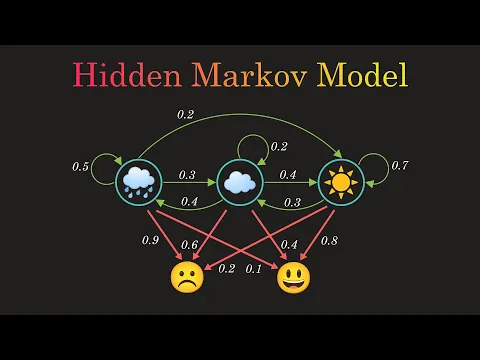
Hidden Markov Models (HMMs) are statistical models that represent systems as a set of hidden states and observable sequences. They are widely used for sequential data modeling, where the system evolves over time and only observable data points can be seen, while the underlying states remain hidden.
Video Explanation
Characteristics:
-
Probabilistic Transitions:
The model represents transitions between states as probabilities. Each state has a probability of transitioning to another state or staying the same. -
Hidden and Observable States:
HMMs have two types of states: hidden states, which define the unobserved structure, and observable states, which can be directly measured. -
Sequence Modeling:
HMMs are suitable for time-series data, natural language processing, and speech recognition, where the sequence order and probabilistic dependencies are important.
Key Concepts:
-
States:
States in HMMs are categorized into hidden states (not directly observed) and observable states (can be observed). Examples include the weather (hidden) and umbrella usage (observable). -
Transition Probabilities:
Defines the probability of transitioning from one hidden state to another, representing the likelihood of moving between different states in the system. -
Emission Probabilities:
The probability of observing a particular observation given a hidden state, representing how likely an observation is based on the hidden state. -
Initial State Distribution:
The probability of starting in each hidden state at the beginning of the sequence.
Hidden Markov Model Process:
-
Define States and Observations:
Identify the hidden and observable states based on the system or data structure. -
Specify Parameters:
Determine the transition and emission probabilities and initial state distribution based on training data or domain knowledge. -
Train the Model:
Use data to estimate the parameters (transition, emission probabilities, etc.) or utilize algorithms like the Baum-Welch for training. -
Inference with the Model:
Use algorithms like the Viterbi algorithm for the most probable state sequence or the Forward-Backward algorithm to calculate the probability of a sequence.
HMM Algorithm Steps:
-
Initialize Model Parameters:
Define initial probabilities for states, transition probabilities, and emission probabilities. -
Calculate Forward Probabilities:
Use the Forward algorithm to compute the probability of observing a sequence given the model. -
Compute Backward Probabilities:
Apply the Backward algorithm to find probabilities of observing the remaining part of the sequence, starting from each hidden state. -
Viterbi Algorithm:
Use the Viterbi algorithm to determine the most likely sequence of hidden states given the observations.
Parameters:
-
Transition Probability Matrix:
A matrix where each cell ((i, j)) represents the probability of transitioning from state (i) to state (j). -
Emission Probability Matrix:
Each cell represents the probability of an observable state given a hidden state. -
Initial State Probability Vector:
Vector specifying the starting probability of each state in the sequence.
Advantages of HMM:
-
Captures Temporal Dependencies:
Ideal for sequential and time-series data, where the order of events is crucial. -
Good for Partially Observable Data:
Useful in situations where only partial data (observations) is visible, but underlying states are hidden.
Disadvantages of HMM:
-
Limited to Markov Assumptions:
Assumes that future states depend only on the current state, which may be restrictive for some applications. -
Parameter Estimation Complexity:
Requires large amounts of data for accurate parameter estimation, which can be computationally intensive.
Python Implementation:
Here is an example implementation of HMM using hmmlearn:
import numpy as np
from hmmlearn import hmm

# Define states and observations
states = ["Rainy", "Sunny"]
observations = ["walk", "shop", "clean"]

# Convert to numerical format
state_map = {state: i for i, state in enumerate(states)}
obs_map = {obs: i for i, obs in enumerate(observations)}

# Initialize the model
model = hmm.MultinomialHMM(n_components=len(states), n_iter=100)

# Define model parameters (probabilities should sum to 1)
model.startprob_ = np.array([0.6, 0.4])  # Initial state distribution
model.transmat_ = np.array([
    [0.7, 0.3],  # Transition probabilities from "Rainy"
    [0.4, 0.6]   # Transition probabilities from "Sunny"
])
model.emissionprob_ = np.array([
    [0.1, 0.4, 0.5],  # Emission probabilities for "Rainy"
    [0.6, 0.3, 0.1]   # Emission probabilities for "Sunny"
])

# Define an observation sequence
obs_seq = np.array([[obs_map["walk"]], [obs_map["shop"]], [obs_map["clean"]]])

# Fit the model (if training needed) and predict hidden states
model.fit(obs_seq)
logprob, hidden_states = model.decode(obs_seq, algorithm="viterbi")

print("Most likely hidden states:", [states[state] for state in hidden_states])
HMM Parameters:
In the example above:
startprob_: Specifies the initial state probabilities.transmat_: Defines the transition probability matrix.emissionprob_: Specifies the emission probability matrix for each observable state.
Choosing Parameters:
-
Transition and Emission Probabilities:
Should be estimated from training data or set based on domain knowledge. -
Initial State Probabilities:
Choose initial probabilities that match the expected start of sequences.
Summary:
Hidden Markov Models (HMMs) are effective for modeling sequential data with hidden and observable states. They are widely used for applications involving time-dependent or sequence data, such as speech recognition, natural language processing, and bioinformatics. By representing complex systems with hidden states and probabilistic transitions, HMMs offer powerful tools for analyzing data with underlying temporal structures.
Done with this topic? Mark it as complete to track your progress.
Was this page helpful?
Discuss this page
Have a question or spot something confusing in "Hidden Markov Models (HMM) Algorithm"? Ask below. Backed by GitHub Discussions—maintainers receive system notifications directly.