Breadth-First Search (BFS)
Breadth-First Search (BFS) is a fundamental graph traversal algorithm that explores all the vertices of a graph at the present depth level before moving on to the vertices at the next depth level.
BFS is the best algorithm to find the shortest path on an unweighted graph, as it naturally explores nodes in increasing order of distance from the source.
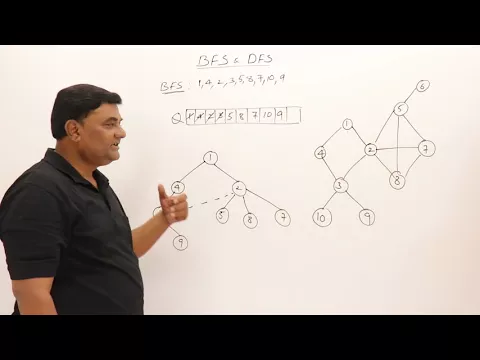
Video Explanation
Interactive Visualization
Below is an interactive graph visualizer. You can select the Breadth-First Search (BFS) algorithm from the dropdown, click Start Simulation to watch it traverse the graph level-by-level, or switch to Edit Graph Mode to customize nodes and edges!
How It Works
BFS uses a Queue (FIFO) data structure to keep track of the vertices to visit next.
Steps
- Start by putting the source node in a queue and marking it as visited.
- While the queue is not empty:
- Dequeue a node from the front of the queue.
- For every unvisited neighbor of this node:
- Mark it as visited.
- Enqueue it at the back of the queue.
Complexity Analysis
| Metric | Value |
|---|---|
| Time Complexity | O(V + E) |
| Space Complexity | O(V) |
Where V = number of vertices, E = number of edges.
Implementations
Python
from collections import deque

def bfs(graph, start):
    visited = set()
    queue = deque([start])
    visited.add(start)

    result = []
    while queue:
        node = queue.popleft()
        result.append(node)

        for neighbor in graph[node]:
            if neighbor not in visited:
                visited.add(neighbor)
                queue.append(neighbor)
    return result

# Example graph represented as an adjacency list
graph = {
    0: [1, 2],
    1: [0, 3, 4],
    2: [0, 5],
    3: [1],
    4: [1],
    5: [2]
}
print(bfs(graph, 0)) # Output: [0, 1, 2, 3, 4, 5]
Java
import java.util.*;

public class BFS {
    public static void bfs(List<List<Integer>> graph, int start) {
        boolean[] visited = new boolean[graph.size()];
        Queue<Integer> queue = new LinkedList<>();

        visited[start] = true;
        queue.add(start);

        while (!queue.isEmpty()) {
            int node = queue.poll();
            System.out.print(node + " ");

            for (int neighbor : graph.get(node)) {
                if (!visited[neighbor]) {
                    visited[neighbor] = true;
                    queue.add(neighbor);
                }
            }
        }
    }
}
C++
#include <iostream>
#include <vector>
#include <queue>

using namespace std;

void bfs(vector<vector<int>>& graph, int start) {
    vector<bool> visited(graph.size(), false);
    queue<int> q;

    visited[start] = true;
    q.push(start);

    while (!q.empty()) {
        int node = q.front();
        q.pop();
        cout << node << " ";

        for (int neighbor : graph[node]) {
            if (!visited[neighbor]) {
                visited[neighbor] = true;
                q.push(neighbor);
            }
        }
    }
}
JavaScript
function bfs(graph, start) {
    const visited = new Set();
    const queue = [start];
    visited.add(start);

    const result = [];

    while (queue.length > 0) {
        const node = queue.shift();
        result.push(node);

        for (const neighbor of graph[node]) {
            if (!visited.has(neighbor)) {
                visited.add(neighbor);
                queue.push(neighbor);
            }
        }
    }
    return result;
}
Real-World Use Cases
- Social Networks — Finding people within a certain degree of separation (e.g., friends of friends).
- Web Crawlers — Search engines like Google use BFS to crawl links on a page level by level.
- GPS Navigation — Finding the shortest route if all roads have the same length.
Test Your Understanding
Answer these 3 questions to check what you have learned.
What data structure does BFS use internally?
What is the time complexity of BFS with V vertices and E edges?
BFS guarantees the shortest path in terms of:
Done with this topic? Mark it as complete to track your progress.
Was this page helpful?
Discuss this page
Have a question or spot something confusing in "Breadth-First Search (BFS)"? Ask below. Backed by GitHub Discussions—maintainers receive system notifications directly.