lasso_regression
id: lasso-regression
title: "Lasso Regression Algorithm"
sidebar_label: Lasso Regression
description: "In this post, we’ll explore Lasso Regression, a regularization technique in supervised learning that helps prevent overfitting by adding a penalty to the loss function."
tags: [machine learning, algorithms, supervised learning, regression, lasso regression]
Definition:
Lasso Regression (Least Absolute Shrinkage and Selection Operator) is a type of linear regression that uses L1 regularization to enhance the prediction accuracy and interpretability of the statistical model it produces. By adding a penalty equal to the absolute value of the magnitude of coefficients, Lasso can shrink some coefficients to zero, effectively performing variable selection.
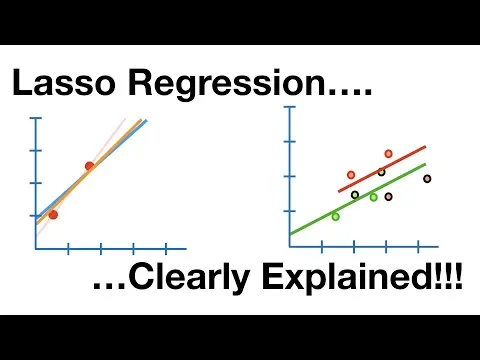
Video Explanation
Characteristics:
-
Regularization:
Lasso Regression includes a penalty term in the loss function that discourages overly complex models by constraining the coefficients. -
Feature Selection:
By driving some coefficients to zero, Lasso effectively selects a simpler model that uses only a subset of the features. -
Continuous Output:
Like other regression algorithms, Lasso is used for predicting continuous outcomes.
Steps Involved:
-
Input the Data:
The algorithm receives labeled training data consisting of features and corresponding target values. -
Preprocess the Data:
Data cleaning and preprocessing steps may include handling missing values, normalizing or scaling features, and encoding categorical variables. -
Split the Dataset:
The dataset is typically split into training and testing sets to evaluate model performance. -
Select a Model:
Choose Lasso Regression as the appropriate regression algorithm based on the problem type and data characteristics. -
Train the Model:
Fit the model to the training data using an optimization algorithm that minimizes error while applying L1 regularization. -
Evaluate Model Performance:
Use metrics such as Mean Squared Error (MSE) or R² score to assess how well the model performs on unseen data. -
Make Predictions:
Use the trained model to make predictions on new data points.
Problem Statement:
Given a labeled dataset with multiple features and corresponding continuous target values, the objective is to train a Lasso Regression model that can accurately predict target values for new, unseen data based on learned patterns while performing feature selection.
Key Concepts:
-
Regularization Parameter (α):
The strength of the penalty applied to coefficients; higher values lead to more regularization and simpler models. -
Training Set:
The portion of the dataset used to train the model. -
Test Set:
The portion of the dataset used to evaluate model performance after training. -
Overfitting and Underfitting:
Overfitting occurs when a model learns noise in the training data rather than general patterns. Underfitting occurs when a model is too simple to capture underlying trends.
Split Criteria:
Lasso Regression typically splits data based on minimizing prediction error while incorporating regularization effects in coefficient estimation.
Time Complexity:
-
Training Complexity:
Varies by algorithm; for Lasso Regression, it can be more computationally intensive than standard linear regression due to optimization with regularization. -
Prediction Complexity:
Similar to linear regression; once trained, predictions are generally quick.
Space Complexity:
- Space Complexity:
Depends on how much information about the training set needs to be stored; typically lower than tree-based models because it maintains fewer parameters.
Example:
Consider a scenario where we want to predict house prices based on features such as size, number of bedrooms, and location while also performing feature selection.
Dataset Example:
| Size (sq ft) | Bedrooms | Age (years) | Price ($) |
|---|---|---|---|
| 1500 | 3 | 10 | 300000 |
| 2000 | 4 | 5 | 400000 |
| 1200 | 2 | 15 | 250000 |
| 1800 | 3 | 8 | 350000 |
Step-by-Step Execution:
-
Input Data:
The model receives training data with features (size, bedrooms, age) and labels (price). -
Preprocess Data:
Handle any missing values or outliers if necessary. -
Split Dataset:
Divide the dataset into training and testing sets (e.g., 80% train, 20% test). -
Select Model:
Choose Lasso Regression as your regression algorithm. -
Train Model:
Fit the model using the training set with an appropriate value for α (the regularization parameter). -
Evaluate Performance:
Use metrics like R² score or mean squared error on the test set. -
Make Predictions:
Predict prices for new houses based on their features.
Python Implementation:
Here’s a basic implementation of Lasso Regression using scikit-learn:
from sklearn.model_selection import train_test_split
from sklearn.linear_model import Lasso
from sklearn.metrics import mean_squared_error

# Sample dataset
data = {
    'Size': [1500, 2000, 1200, 1800],
    'Bedrooms': [3, 4, 2, 3],
    'Age': [10, 5, 15, 8],
    'Price': [300000, 400000, 250000, 350000]
}

# Convert to DataFrame
import pandas as pd
df = pd.DataFrame(data)

# Features and target variable
X = df[['Size', 'Bedrooms', 'Age']]
y = df['Price']

# Split dataset
X_train, X_test, y_train, y_test = train_test_split(X, y, test_size=0.2, random_state=42)

# Create Lasso Regression model
model = Lasso(alpha=0.1) # You can adjust alpha for regularization strength

# Train model
model.fit(X_train, y_train)

# Predict
y_pred = model.predict(X_test)

# Evaluate
mse = mean_squared_error(y_test, y_pred)
print(f"Mean Squared Error: {mse:.2f}")
Done with this topic? Mark it as complete to track your progress.
Was this page helpful?
Discuss this page
Have a question or spot something confusing in "lasso_regression"? Ask below. Backed by GitHub Discussions—maintainers receive system notifications directly.