Floyd-Warshall Algorithm
Floyd-Warshall Algorithm
Introduction
The Floyd-Warshall Algorithm is a classic Dynamic Programming algorithm used to find the shortest paths between all pairs of vertices in a weighted graph.
Unlike algorithms such as:
- Dijkstra’s Algorithm
- Bellman-Ford Algorithm
which solve the single-source shortest path problem, Floyd-Warshall computes the shortest distance between every pair of vertices.
The algorithm works for:
- Directed graphs
- Undirected graphs
- Graphs with negative edge weights
However, it does not work correctly for graphs containing negative weight cycles.
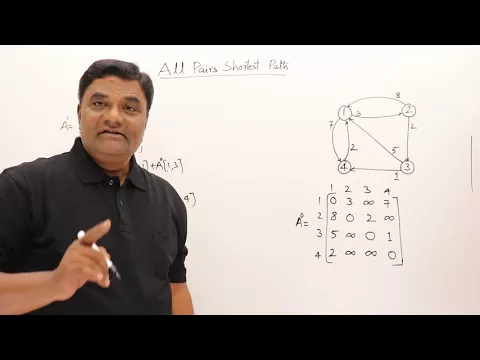
Video Explanation
Dynamic Programming Concept
The Floyd-Warshall Algorithm gradually improves the shortest path between every pair of vertices by considering each vertex as an intermediate node.
The core DP transition is:
[ dist[i][j] = \min(dist[i][j], dist[i][k] + dist[k][j]) ]
Where:
dist[i][j]→ shortest distance from vertexito vertexjk→ intermediate vertex
How the Algorithm Works
- Create an adjacency matrix.
- Initialize:
- Distance to self as
0 - Unreachable vertices as
INF
- Distance to self as
- Iterate through all vertices as intermediate nodes.
- Update shortest distances using Dynamic Programming.
- Final matrix contains shortest paths between all pairs of vertices.
Floyd-Warshall Workflow
Implementation in C++
#include <iostream>
#include <vector>

using namespace std;

const int INF = 1000000000;

void floydWarshall(vector<vector<int>>& dist, int V) {
    for (int k = 0; k < V; k++) {
        for (int i = 0; i < V; i++) {
            for (int j = 0; j < V; j++) {
                if (dist[i][k] != INF &&
                    dist[k][j] != INF &&
                    dist[i][k] + dist[k][j] < dist[i][j]) {
                    dist[i][j] = dist[i][k] + dist[k][j];
                }
            }
        }
    }

    cout << "Shortest distance matrix:\n";
    for (int i = 0; i < V; i++) {
        for (int j = 0; j < V; j++) {
            if (dist[i][j] == INF)
                cout << "INF ";
            else
                cout << dist[i][j] << " ";
        }
        cout << endl;
    }
}

int main() {
    int V = 4;
    vector<vector<int>> dist = {
        {0, 3, INF, 7},
        {8, 0, 2, INF},
        {5, INF, 0, 1},
        {2, INF, INF, 0}
    };

    floydWarshall(dist, V);
    return 0;
}
Implementation in Java
public class FloydWarshall {
    static final int INF = 1000000000;

    public static void floydWarshall(int[][] dist, int V) {
        for (int k = 0; k < V; k++) {
            for (int i = 0; i < V; i++) {
                for (int j = 0; j < V; j++) {
                    if (dist[i][k] != INF &&
                        dist[k][j] != INF &&
                        dist[i][k] + dist[k][j] < dist[i][j]) {
                        dist[i][j] = dist[i][k] + dist[k][j];
                    }
                }
            }
        }

        printSolution(dist, V);
    }

    public static void printSolution(int[][] dist, int V) {
        System.out.println("Shortest distance matrix:");
        for (int i = 0; i < V; i++) {
            for (int j = 0; j < V; j++) {
                if (dist[i][j] == INF)
                    System.out.print("INF ");
                else
                    System.out.print(dist[i][j] + " ");
            }
            System.out.println();
        }
    }

    public static void main(String[] args) {
        int V = 4;
        int[][] graph = {
            {0, 3, INF, 7},
            {8, 0, 2, INF},
            {5, INF, 0, 1},
            {2, INF, INF, 0}
        };

        floydWarshall(graph, V);
    }
}
Implementation in Python
INF = 1000000000

def floyd_warshall(dist, V):
    for k in range(V):
        for i in range(V):
            for j in range(V):
                if dist[i][k] != INF and dist[k][j] != INF and dist[i][k] + dist[k][j] < dist[i][j]:
                    dist[i][j] = dist[i][k] + dist[k][j]

    print("Shortest distance matrix:")
    for i in range(V):
        row = []
        for j in range(V):
            if dist[i][j] == INF:
                row.append("INF")
            else:
                row.append(str(dist[i][j]))
        print(" ".join(row))

if __name__ == "__main__":
    V = 4
    graph = [
        [0, 3, INF, 7],
        [8, 0, 2, INF],
        [5, INF, 0, 1],
        [2, INF, INF, 0]
    ]

    floyd_warshall(graph, V)
Example
Input Graph
Adjacency Matrix Representation
      0    1    2    3
0     0    3   INF   7
1     8    0    2   INF
2     5   INF   0    1
3     2   INF  INF   0
Output
0 3 5 6
5 0 2 3
3 6 0 1
2 5 7 0
DP Transition Visualization
Time Complexity
The Floyd-Warshall Algorithm uses three nested loops:
[ O(V^3) ]
Where:
V= Number of vertices
Space Complexity
The algorithm stores a distance matrix:
[ O(V^2) ]
Advantages
- Simple and elegant implementation
- Solves All-Pairs Shortest Path efficiently
- Supports negative edge weights
- Works for directed and undirected graphs
- Dynamic Programming based approach
Limitations
- Inefficient for very large sparse graphs
- Cannot handle negative weight cycles
- Requires adjacency matrix representation
- Higher time complexity than single-source shortest path algorithms
Applications
- Network routing algorithms
- Traffic and navigation systems
- Graph analysis problems
- Competitive programming
- Dynamic Programming education
- Path optimization systems
Edge Cases Handled
- Directed graphs
- Undirected graphs
- Disconnected graphs
- Negative edge weights
- Single vertex graphs
Points to Remember
- Floyd-Warshall computes shortest paths between all pairs of vertices.
- The algorithm uses Dynamic Programming with matrix optimization.
- Intermediate vertex
kmust remain the outermost loop for correctness. - Works with negative edge weights but fails for negative cycles.
- Distance from a node to itself is always
0.
Conclusion
The Floyd-Warshall Algorithm is one of the most important graph algorithms for solving the All-Pairs Shortest Path problem.
It demonstrates matrix-based Dynamic Programming and provides a powerful approach for optimizing shortest paths incrementally using intermediate vertices.
Related Topics
- Dijkstra's Algorithm: Single-source shortest path for non-negative weighted graphs ().
- Bellman-Ford Algorithm: Single-source shortest path handling negative weight edges ().
- Disjoint Set Union (DSU): Manages connected components and cycle detection ().
Test Your Understanding
Answer these 3 questions to check what you have learned.
What is the main topic of this documentation page?
What should be identified before implementing extra floyd warshall algorithm?
How is understanding of extra floyd warshall algorithm best checked?
Done with this topic? Mark it as complete to track your progress.
Was this page helpful?
Discuss this page
Have a question or spot something confusing in "Floyd-Warshall Algorithm"? Ask below. Backed by GitHub Discussions—maintainers receive system notifications directly.