N Queen Recursion
N Queen Problem | Return all Distinct Solutions to the N-Queens Puzzle
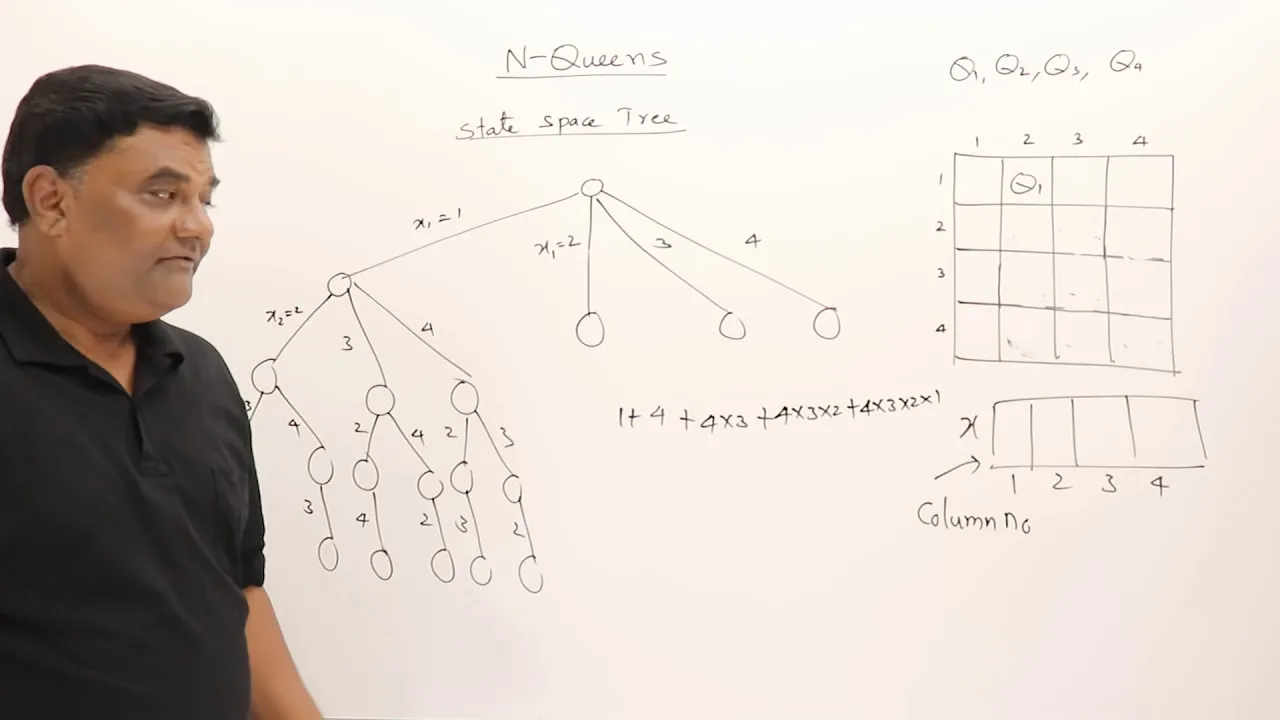
- Problem Statement: The n-queens is the problem of placing n queens on n × n chessboard such that no two queens can attack each other. Given an integer n, return all distinct solutions to the n -queens puzzle. Each solution contains a distinct boards configuration of the queen's placement, where ‘Q’ and ‘.’ indicate queen and empty space respectively.
Video Explanation
#include <bits/stdc++.h>
using namespace std;
class Solution {
  public:
    bool isSafe1(int row, int col, vector < string > board, int n) {
      // check upper element
      int duprow = row;
      int dupcol = col;

      while (row >= 0 && col >= 0) {
        if (board[row][col] == 'Q')
          return false;
        row--;
        col--;
      }

      col = dupcol;
      row = duprow;
      while (col >= 0) {
        if (board[row][col] == 'Q')
          return false;
        col--;
      }

      row = duprow;
      col = dupcol;
      while (row < n && col >= 0) {
        if (board[row][col] == 'Q')
          return false;
        row++;
        col--;
      }
      return true;
    }

  public:
    void solve(int col, vector < string > & board, vector < vector < string >> & ans, int n) {
      if (col == n) {
        ans.push_back(board);
        return;
      }
      for (int row = 0; row < n; row++) {
        if (isSafe1(row, col, board, n)) {
          board[row][col] = 'Q';
          solve(col + 1, board, ans, n);
          board[row][col] = '.';
        }
      }
    }

  public:
    vector < vector < string >> solveNQueens(int n) {
      vector < vector < string >> ans;
      vector < string > board(n);
      string s(n, '.');
      for (int i = 0; i < n; i++) {
        board[i] = s;
      }
      solve(0, board, ans, n);
      return ans;
    }
};
int main() {
  int n = 4; // we are taking 4*4 grid and 4 queens
  Solution obj;
  vector < vector < string >> ans = obj.solveNQueens(n);
  for (int i = 0; i < ans.size(); i++) {
    cout << "Arrangement " << i + 1 << "\n";
    for (int j = 0; j < ans[0].size(); j++) {
      cout << ans[i][j];
      cout << endl;
    }
    cout << endl;
  }
  return 0;
}
Time and Space Complexity
Time Complexity
- Worst Case: - In the worst case, the algorithm explores all possible permutations of placing queens, which can result in configurations being evaluated.
- Best Case: - Even with pruning through the
isSafecheck, the algorithm must still explore many configurations.
Space Complexity
- - The board itself requires space to store the placement of queens.
- - The recursion stack depth is at most since we place queens column by column.
- Total: for the board representation plus for the recursion stack.
Explanation
The N-Queens problem is solved using backtracking with recursion. For each column, the algorithm tries placing a queen in each row, checks if it's safe (not threatened by other queens), and recursively moves to the next column. If a valid placement is found for all columns, it's stored as a solution. If not, the algorithm backtracks and tries the next row. While exponential, the isSafe pruning significantly reduces the search space compared to a brute-force exploration of all positions.
Track Your Progress
Done with this topic? Mark it as complete to track your progress.
Was this page helpful?
💬
Discuss this page
Have a question or spot something confusing in "N Queen Recursion"? Ask below. Backed by GitHub Discussions—maintainers receive system notifications directly.