Bogo Sort
Definition:
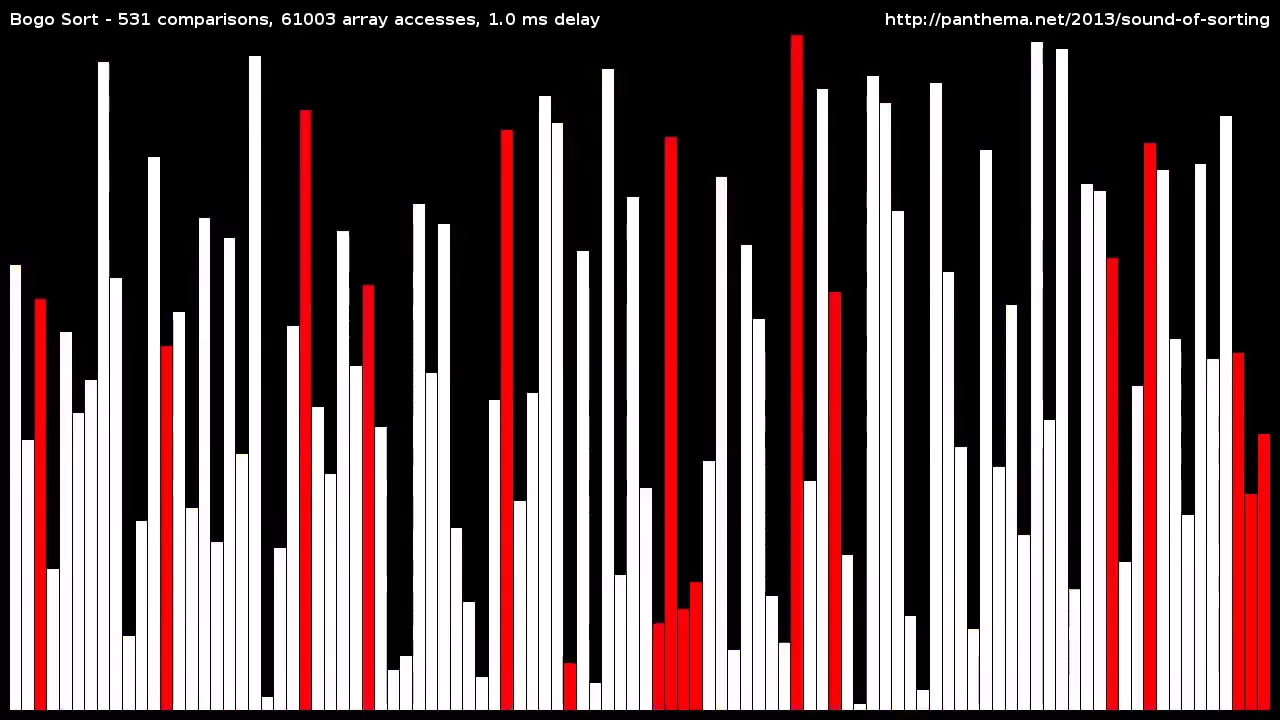
Bogo Sort (also known as permutation sort, stupid sort, or slow sort) is a highly inefficient sorting algorithm based on the generate-and-test paradigm. The algorithm generates random permutations of the array until it finds one that is sorted. It is not practical for large arrays, as its average-case time complexity is extremely poor.
Video Explanation
Characteristics:
-
Generate-and-Test:
- Bogo sort works by randomly shuffling the elements of an array and then checking if the array is sorted. This process repeats until the array is sorted.
-
Highly Inefficient:
- The time complexity of Bogo sort makes it unusable for all but the smallest inputs, as the number of permutations of an array grows factorially with its size.
-
Not In-Place:
- Bogo sort can be in-place or not depending on the implementation, though it's typically done in-place since no extra memory is needed aside from shuffling operations.
-
Not Stable:
- Since elements are randomly shuffled, Bogo sort does not preserve the relative order of equal elements, making it inherently unstable.
Time Complexity:
-
Best Case: O(n)
In the best-case scenario, the array is already sorted on the first check, so only one permutation is generated. -
Average Case: O((n+1)!)
On average, Bogo sort requires generating and checking all possible permutations, leading to factorial time complexity. -
Worst Case: Unbounded
In the worst-case scenario, Bogo sort could theoretically never find a sorted permutation, making the time to complete unbounded.
Space Complexity:
- Space Complexity: O(1)
Bogo sort requires no additional space other than the input array, as it works in-place by shuffling the array.
C++ Implementation:
#include <iostream>
#include <algorithm>
#include <cstdlib>
#include <ctime>
using namespace std;

// Function to check if the array is sorted
bool isSorted(int arr[], int size) {
    for (int i = 0; i < size - 1; i++) {
        if (arr[i] > arr[i + 1]) {
            return false;
        }
    }
    return true;
}

// Function to shuffle the array randomly
void shuffle(int arr[], int size) {
    for (int i = 0; i < size; i++) {
        swap(arr[i], arr[rand() % size]);
    }
}

// Function to perform Bogo sort
void bogoSort(int arr[], int size) {
    while (!isSorted(arr, size)) {
        shuffle(arr, size);
    }
}

int main() {
    srand(time(0));
    int arr[] = {3, 2, 5, 1, 4};
    int size = sizeof(arr) / sizeof(arr[0]);

    bogoSort(arr, size);

    cout << "Sorted array: \n";
    for (int i = 0; i < size; i++) {
        cout << arr[i] << " ";
    }
    cout << endl;

    return 0;
}
Summary:
Bogo sort is a highly inefficient sorting algorithm based on generating random permutations until the array is sorted. With an average-case time complexity of , it is impractical for anything but small arrays or as a teaching tool to illustrate inefficiency. Despite its impracticality, Bogo sort serves as a humorous example of how not to sort a list, given its extreme inefficiency.
The main takeaway is that Bogo sort, while theoretically interesting, should not be used in practice due to its poor performance and high computational cost.
Test Your Understanding
Answer these 3 questions to check what you have learned.
What is the main topic of this documentation page?
What should be identified before implementing bogo sort algo?
How is understanding of bogo sort algo best checked?
Done with this topic? Mark it as complete to track your progress.
Was this page helpful?
Discuss this page
Have a question or spot something confusing in "Bogo Sort"? Ask below. Backed by GitHub Discussions—maintainers receive system notifications directly.