N-Queens Algorithm using Backtracking
N-Queens Algorithm
Introduction
The N-Queens problem is a classic example of constraint satisfaction problems and explores ways to place n queens on an n×n chessboard such that no two queens can attack each other. This challenge is often solved using backtracking techniques and has various applications in algorithm design and artificial intelligence.
Video Explanation
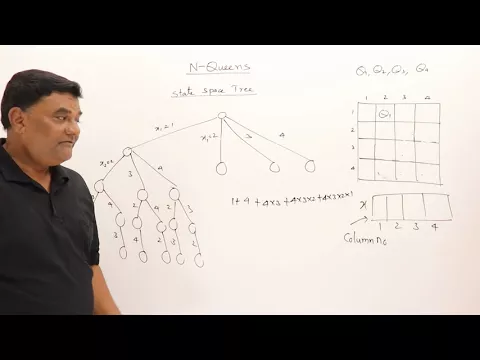
Problem Statement
The goal is to place n queens on an n×n chessboard so that:
- No two queens are in the same row, column, or diagonal.
Approach
Backtracking builds the solution step-by-step, eliminating configurations that violate constraints.
Algorithm
- Place Queen in Row: Place queens one by one in different rows, beginning with the leftmost column.
- Check Safety: For each cell in the current row, check if placing the queen will not conflict with previously placed queens.
- Recursive Backtracking: If a placement is safe, proceed to place the next queen in the following row.
- Backtrack: If placing a queen in a column leads to no solution, remove the queen and try the next cell in the row.
Python Code Implementation
# Function to check if a queen can be placed on the board at [row][col]
def is_safe(board, row, col, n):
    # Checking the left side of the row
    for i in range(col):
        if board[row][i] == 1:
            return False

    # Checking upper diagonal on the left side
    for i, j in zip(range(row, -1, -1), range(col, -1, -1)):
        if board[i][j] == 1:
            return False

    # Checking lower diagonal on the left side
    for i, j in zip(range(row, n), range(col, -1, -1)):
        if board[i][j] == 1:
            return False

    return True

# Function to solve N-Queens using backtracking
def solve_n_queens(board, col, n):
    # If all queens are placed, return True
    if col >= n:
        return True

    # Try placing a queen in each row for this column
    for i in range(n):
        # Check if it's safe to place the queen
        if is_safe(board, i, col, n):
            # Place the queen
            board[i][col] = 1

            # Recur to place the rest of the queens
            if solve_n_queens(board, col + 1, n):
                return True

            # If placing queen at board[i][col] doesn't lead to a solution, remove queen (backtrack)
            board[i][col] = 0

    return False

# Function to initialize the board and call solve_n_queens
def n_queens(n):
    # Initialize an n x n chessboard with all positions set to 0
    board = [[0 for _ in range(n)] for _ in range(n)]
    # Attempt to solve the N-Queens problem
    if solve_n_queens(board, 0, n):
        # If solution exists, print the board
        for row in board:
            print(row)
    else:
        # If no solution exists, print message
        print("No solution exists")

# Driver code to test the above functions
n = int(input("Enter the number of queens (and board size): "))
n_queens(n)
Explanation of Functions
is_safe(board, row, col, n): Checks if it is safe to place a queen at position[row][col]by ensuring no other queens threaten the position from the left side, upper-left diagonal, or lower-left diagonal.solve_n_queens(board, col, n): Solves the problem by placing queens one column at a time. If placing a queen in a specific cell doesn’t lead to a solution, it backtracks.n_queens(n): Initializes the board and starts the recursive process by calling solve_n_queens. If a solution is found, it prints the board configuration; otherwise, it outputs that no solution exists.
Complexity
- Time Complexity: The time complexity is O(N!) due to the combinatorial nature of queen placements.
- Space Complexity: The space complexity is 𝑂(N2) because an n×n board is used to store the board configuration.
Example Walkthrough
For a 4x4 board, the algorithm would place the queens row by row, backtracking as necessary until it finds a valid solution:
- Initial Placement: The algorithm places the first queen in the top-left cell.
- Row-by-Row Backtracking: As it tries to place each subsequent queen, it checks for safety, backtracks when conflicts arise, and adjusts placements until a valid configuration is found.
Visual Representation with Mermaid Diagram
Here's a conceptual flow of the backtracking process in the N-Queens algorithm:
Note: This algorithm is adapted from GeeksforGeeks.
Test Your Understanding
Answer these 3 questions to check what you have learned.
What is the main topic of this documentation page?
What should be identified before implementing n queens backtracking?
How is understanding of n queens backtracking best checked?
Done with this topic? Mark it as complete to track your progress.
Was this page helpful?
Discuss this page
Have a question or spot something confusing in "N-Queens Algorithm using Backtracking"? Ask below. Backed by GitHub Discussions—maintainers receive system notifications directly.