Caesar Cipher Implementation
Caesar Cipher Implementation
Description
The Caesar Cipher is a type of substitution cipher where each letter in the plaintext is shifted by a certain number of positions down or up the alphabet. It is one of the simplest and most widely known encryption techniques.
Video Explanation
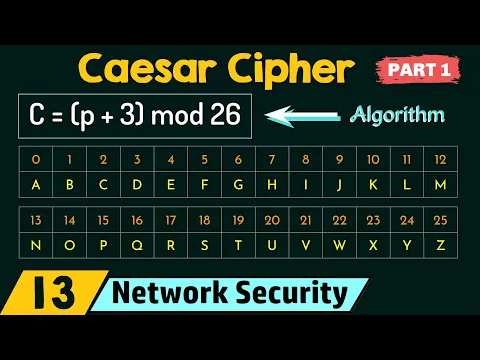
Problem Definition
- Input: A string
textand an integershiftrepresenting the number of positions each letter should be shifted. - Output: Return the encrypted string by shifting each letter in the input string by the given shift value. Non-alphabetic characters should remain unchanged.
Example
-
Input:
text = "HELLO"shift = 3
-
Output:
"KHOOR"
-
Input:
text = "caesar cipher"shift = 2
-
Output:
"ecguct ekrjgt"
Algorithm Overview
- Traverse each character in the input string.
- If the character is a letter, shift it by the given
shiftvalue.- For lowercase letters, ensure it wraps around 'z' to 'a'.
- For uppercase letters, ensure it wraps around 'Z' to 'A'.
- If the character is non-alphabetic (e.g., spaces, punctuation), leave it unchanged.
- Return the encrypted string.
Time Complexity
- Best Case: O(n)
- Average Case: O(n)
- Worst Case: O(n)
where
nis the length of the input string. Each character in the string is processed exactly once.
Space Complexity
- O(n)
where
nis the length of the string, since a new string is created to store the encrypted result.
Explanation
The Caesar Cipher shifts each character individually, meaning the time required is proportional to the number of characters in the string O(n). The space complexity is also O(n) because the algorithm constructs a new string to store the encrypted text. If modifying a mutable string array in place, the space complexity would be O(1).
C++ Implementation
#include <iostream>
#include <string>
using namespace std;

string caesarCipher(string text, int shift) {
    string result = "";

    // Traverse each character in the input string
    for (int i = 0; i < text.length(); i++) {
        char c = text[i];

        // Encrypt uppercase letters
        if (isupper(c)) {
            result += char(int(c + shift - 'A') % 26 + 'A');
        }
        // Encrypt lowercase letters
        else if (islower(c)) {
            result += char(int(c + shift - 'a') % 26 + 'a');
        }
        // Leave non-alphabetic characters unchanged
        else {
            result += c;
        }
    }
    return result;
}

int main() {
    string text = "HELLO";
    int shift = 3;

    cout << "Original text: " << text << endl;
    cout << "Encrypted text: " << caesarCipher(text, shift) << endl;

    return 0;
}
Test Your Understanding
Answer these 3 questions to check what you have learned.
What is the main topic of this documentation page?
What should be identified before implementing caesar cipher implementation?
How is understanding of caesar cipher implementation best checked?
Done with this topic? Mark it as complete to track your progress.
Was this page helpful?
Discuss this page
Have a question or spot something confusing in "Caesar Cipher Implementation"? Ask below. Backed by GitHub Discussions—maintainers receive system notifications directly.