Fractional Knapsack Algorithm
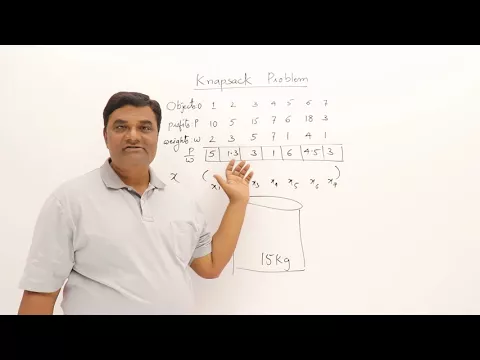
The Fractional Knapsack problem is an optimization problem where, given a set of items with specified weights and values, the goal is to maximize the total value within a weight limit by taking fractions of items. The greedy algorithm for this problem prioritizes items based on their value-to-weight ratio, allowing partial items to be selected if they maximize the overall value.
Video Explanation
Characteristics:
Greedy Approach:
The algorithm selects items based on the highest value-to-weight ratio first. This ensures that the item providing the most value per unit weight is prioritized.
Optimal Solution:
The greedy approach is optimal for the fractional knapsack problem, as allowing fractional parts of items enables us to maximize the value without exceeding the weight limit.
Steps Involved:
Calculate Value-to-Weight Ratio: For each item, calculate the ratio of value to weight. This ratio will be used to prioritize item selection.
Sort Items by Ratio:
Sort all items in descending order of their value-to-weight ratios to ensure the item providing the most value per unit weight is selected first.
Select Items Based on Weight Capacity:
Traverse the sorted items, adding them fully if their weight doesn't exceed the remaining capacity. If an item’s weight is too large, take only a fraction of it to fill the remaining capacity.
Problem Statement:
Given a knapsack with a weight limit of W and a list of items, each with a value vi and weight wi, maximize the total value by selecting items (or fractions thereof) without exceeding W.
Time Complexity:
Best, Average, and Worst Case: Where n is the number of items. Sorting items by their value-to-weight ratio takes O(n \log n) time.
Space Complexity:
Space Complexity: Space is required to store item information and ratios.
Example: Consider a knapsack with a weight limit of W = 50 and the following items:
Items: {(value: 60, weight: 10), (value: 100, weight: 20), (value: 120, weight: 30)}
Sorted by ratio: {(value: 60, weight: 10), (value: 100, weight: 20), (value: 120, weight: 30)}
Step-by-Step Execution:
Add item with weight 10 (value-to-weight ratio 6): Total weight = 10, total value = 60.
Add item with weight 20 (value-to-weight ratio 5): Total weight = 30, total value = 160.
Add 2/3 of item with weight 30 (value-to-weight ratio 4): Total weight = 50, total value = 240.
Total Value: 240
C++ Implementation:
cpp

#include <iostream>
#include <vector>
#include <algorithm>

using namespace std;

// Structure to represent an item
struct Item {
    int value, weight;
};

// Comparator function to sort items by value-to-weight ratio
bool compare(Item a, Item b) {
    double r1 = (double)a.value / a.weight;
    double r2 = (double)b.value / b.weight;
    return r1 > r2;
}

// Function to perform fractional knapsack
double fractionalKnapsack(int W, vector<Item>& items) {
    // Sort items by descending value-to-weight ratio
    sort(items.begin(), items.end(), compare);

    int curWeight = 0;
    double finalValue = 0.0;

    for (auto item : items) {
        if (curWeight + item.weight <= W) {
            // If the item can be added fully
            curWeight += item.weight;
            finalValue += item.value;
        } else {
            // Take fraction of the item to fill the remaining capacity
            int remainingWeight = W - curWeight;
            finalValue += item.value * ((double)remainingWeight / item.weight);
            break;
        }
    }
    return finalValue;
}

int main() {
    int W = 50; // Weight limit of the knapsack
    vector<Item> items = { {60, 10}, {100, 20}, {120, 30} };

    cout << "Maximum value we can obtain = " << fractionalKnapsack(W, items);
    return 0;
}
Java Implementation:
java

import java.util.ArrayList;
import java.util.Collections;
import java.util.Comparator;
import java.util.List;

class Item {
    int value, weight;

    Item(int value, int weight) {
        this.value = value;
        this.weight = weight;
    }
}

public class FractionalKnapsack {

    // Comparator to sort items by value-to-weight ratio
    static class ItemComparator implements Comparator<Item> {
        public int compare(Item a, Item b) {
            double r1 = (double) a.value / a.weight;
            double r2 = (double) b.value / b.weight;
            return Double.compare(r2, r1);
        }
    }

    // Function to perform fractional knapsack
    public static double fractionalKnapsack(int W, List<Item> items) {
        Collections.sort(items, new ItemComparator());

        int curWeight = 0;
        double finalValue = 0.0;

        for (Item item : items) {
            if (curWeight + item.weight <= W) {
                // Add full item
                curWeight += item.weight;
                finalValue += item.value;
            } else {
                // Add fraction of item
                int remainingWeight = W - curWeight;
                finalValue += item.value * ((double) remainingWeight / item.weight);
                break;
            }
        }
        return finalValue;
    }

    public static void main(String[] args) {
        int W = 50; // Knapsack weight limit
        List<Item> items = new ArrayList<>();
        items.add(new Item(60, 10));
        items.add(new Item(100, 20));
        items.add(new Item(120, 30));

        System.out.println("Maximum value we can obtain = " + fractionalKnapsack(W, items));
    }
}
Summary: The Fractional Knapsack algorithm maximizes the total value of items in a knapsack with a weight limit by selecting items (or fractions of them) based on their value-to-weight ratio. This approach is widely applicable in resource allocation, inventory management, and financial investments. While the 0/1 knapsack problem is NP-complete, the fractional variant is solvable in polynomial time, making it efficient and optimal. The greedy algorithm ensures the maximum possible value within the given constraints.
Done with this topic? Mark it as complete to track your progress.
Was this page helpful?
Discuss this page
Have a question or spot something confusing in "Fractional Knapsack Algorithm"? Ask below. Backed by GitHub Discussions—maintainers receive system notifications directly.