Exponential Search
Definition:
Exponential search is an algorithm that searches for a target element in a sorted array. It combines binary search with exponential growth to quickly identify a range where the target element may exist and then applies binary search within that range.
Characteristics:
-
Exponentially Grows Search Range:
- Exponential search starts by checking the first element, then elements at exponentially increasing indices (1, 2, 4, 8, …) until it exceeds the target.
-
Binary Search in Identified Range:
- Once the range is identified, a binary search is applied within that range to find the target element.
Video Explanation
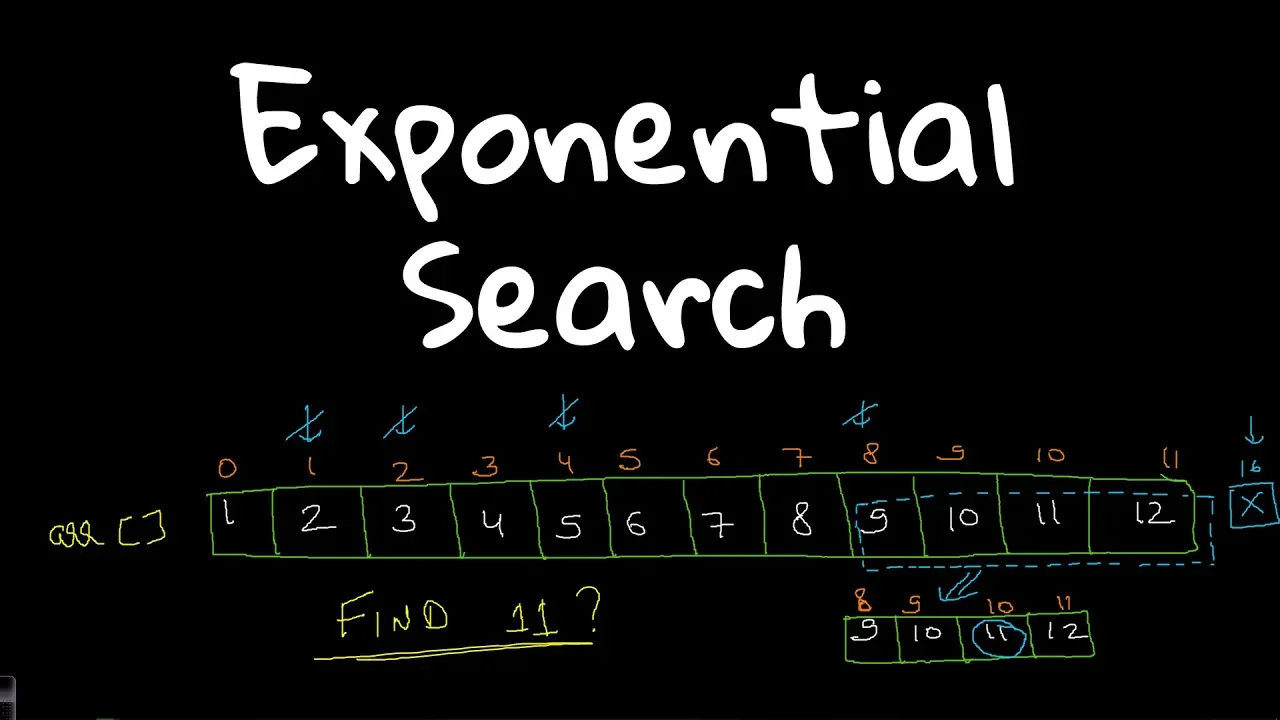
Time Complexity:
-
Best Case:
If the target element is at the first position, it is found in constant time. -
Average and Worst Case:
The exponential growth phase takes , whereiis the position where the range is identified. The binary search within the range also takes .
Space Complexity:
- Iterative:
The iterative approach requires only a few variables for managing indices.
C++ Implementation:
#include <iostream>
#include <algorithm>
using namespace std;

int binarySearch(int arr[], int low, int high, int target) {
    while (low <= high) {
        int mid = low + (high - low) / 2;

        if (arr[mid] == target) return mid;
        else if (arr[mid] < target) low = mid + 1;
        else high = mid - 1;
    }
    return -1;
}

int exponentialSearch(int arr[], int size, int target) {
    if (arr[0] == target) return 0;

    int i = 1;
    while (i < size && arr[i] <= target) {
        i *= 2;
    }

    return binarySearch(arr, i / 2, min(i, size - 1), target);
}

int main() {
    int arr[] = {3, 5, 7, 9, 10, 14, 18, 21, 25};
    int size = sizeof(arr) / sizeof(arr[0]);
    int target = 14;

    int result = exponentialSearch(arr, size, target);

    if (result != -1) {
        cout << "Element found at index " << result << endl;
    } else {
        cout << "Element not found" << endl;
    }

    return 0;
}
Use Cases:
-
Searching in Infinite Lists:
- Exponential search is particularly useful when dealing with data that can grow indefinitely or when the length of the dataset is not known beforehand.
-
Dynamic Datasets:
- It can be applied in scenarios where data is continuously added, allowing efficient searches even in dynamic datasets.
Advantages and Disadvantages:
Advantages:
-
Works with Unbounded Arrays:
- The ability to search in unbounded or infinite arrays makes exponential search a unique tool in specific applications.
-
Combines Best of Both Worlds:
- By leveraging both exponential and binary search, it effectively narrows down search space while maintaining efficiency.
Disadvantages:
-
Requires Sorted Data:
- Like binary search, exponential search requires the data to be sorted, limiting its application in unsorted datasets.
-
Overhead in Range Determination:
- The initial phase of finding the range can introduce additional overhead compared to direct binary search in known datasets.
Optimizations and Applications:
- Faster Range Detection:
- Exponential search can improve the efficiency of finding the target in large datasets by quickly locating the range, making it suitable for various search problems.
Summary:
Exponential search is a specialized search algorithm that efficiently locates an element in infinite or unbounded datasets by first establishing a range and then applying binary search. Its unique design makes it suitable for dynamic datasets where the length is not known, while still maintaining the requirement for sorted data.
Test Your Understanding
Answer these 3 questions to check what you have learned.
What is the main topic of this documentation page?
What should be identified before implementing exponential search algo?
How is understanding of exponential search algo best checked?
Done with this topic? Mark it as complete to track your progress.
Was this page helpful?
Discuss this page
Have a question or spot something confusing in "Exponential Search"? Ask below. Backed by GitHub Discussions—maintainers receive system notifications directly.