Generics
Generics
What are Generics?
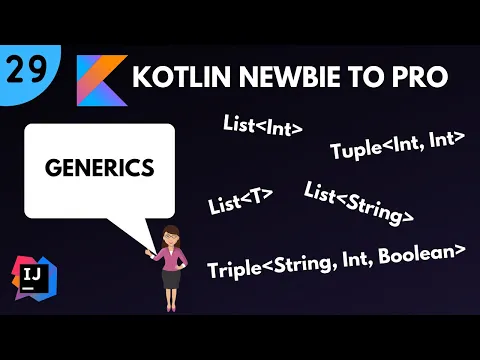
Generics allow you to write type-safe, reusable code that works with different data types without sacrificing type safety. Instead of writing separate classes for each type, you write one class with a type parameter.
Video Explanation
Generic Functions
fun <T : Any> printItem(item: T) {
    println("Item: $item (${item::class.simpleName})")
}

fun main() {
    printItem(42)
    printItem("Hello")
    printItem(3.14)
    printItem(true)
}
Generic Function with Return Type
fun <T> identity(value: T): T = value

fun main() {
    val name: String = identity("Kotlin")
    val num: Int = identity(100)
    println(name)  // Kotlin
    println(num)   // 100
}
Generic Classes
class Box<T : Any>(val value: T) {
    fun getValue(): T = value
    fun describe() = println("Box contains: $value (${value::class.simpleName})")
}

fun main() {
    val intBox    = Box(42)
    val strBox    = Box("Hello")
    val listBox   = Box(listOf(1, 2, 3))

    intBox.describe()     // Box contains: 42 (Int)
    strBox.describe()     // Box contains: Hello (String)
    listBox.describe()    // Box contains: [1, 2, 3] (ArrayList)
}
Generic Interfaces
interface Repository<T> {
    fun findById(id: Int): T?
    fun save(item: T)
    fun getAll(): List<T>
}

data class User(val id: Int, val name: String)

class UserRepository : Repository<User> {
    private val users = mutableListOf<User>()

    override fun findById(id: Int) = users.find { it.id == id }
    override fun save(item: User) { users.add(item) }
    override fun getAll() = users.toList()
}

fun main() {
    val repo = UserRepository()
    repo.save(User(1, "Alice"))
    repo.save(User(2, "Bob"))
    println(repo.findById(1))   // User(id=1, name=Alice)
    println(repo.getAll())
}
Type Constraints (Upper Bounds)
Restrict what types can be used as a type argument:
fun <T : Number> sum(a: T, b: T): Double {
    return a.toDouble() + b.toDouble()
}

fun main() {
    println(sum(3, 4))         // 7.0
    println(sum(1.5, 2.5))     // 4.0
    // sum("a", "b")  // ERROR: String is not a Number
}
Multiple Constraints with where
fun <T> printIfComparable(a: T, b: T)
        where T : Comparable<T>, T : Any {
    if (a > b) println("$a > $b") else println("$a <= $b")
}

fun main() {
    printIfComparable(5, 3)         // 5 > 3
    printIfComparable("abc", "xyz") // abc <= xyz
}
Variance: out and in
out — Covariant (Producer)
A Box<out T> can only produce T values (read-only):
class Printer<out T>(val content: T) {
    fun print() = println(content)
}

fun printAnything(printer: Printer<Any>) {
    printer.print()
}

fun main() {
    val strPrinter = Printer("Hello")
    printAnything(strPrinter)  // OK because of 'out'
}
in — Contravariant (Consumer)
A Box<in T> can only consume T values (write-only):
class Writer<in T> {
    fun write(value: T) = println("Writing: $value")
}

fun writeNumber(writer: Writer<Number>) {
    writer.write(3.14)
}

fun main() {
    val anyWriter = Writer<Any>()
    writeNumber(anyWriter)  // OK because of 'in'
}
Star Projection
Use * when the type argument is unknown:
fun printList(list: List<*>) {
    list.forEach { println(it) }
}

fun main() {
    printList(listOf(1, 2, 3))
    printList(listOf("a", "b", "c"))
}
Reified Type Parameters
Use reified with inline to access type info at runtime:
inline fun <reified T> isType(value: Any): Boolean {
    return value is T
}

inline fun <reified T> filterByType(list: List<Any>): List<T> {
    return list.filterIsInstance<T>()
}

fun main() {
    println(isType<String>("hello"))  // true
    println(isType<Int>("hello"))     // false

    val mixed: List<Any> = listOf(1, "a", 2, "b", 3)
    val strings = filterByType<String>(mixed)
    val ints = filterByType<Int>(mixed)

    println(strings)  // [a, b]
    println(ints)     // [1, 2, 3]
}
Generic Stack Example
class Stack<T> {
    private val elements = mutableListOf<T>()

    fun push(element: T) = elements.add(element)
    fun pop(): T = elements.removeLastOrNull() ?: throw NoSuchElementException("Stack is empty")
    fun peek(): T = elements.lastOrNull() ?: throw NoSuchElementException("Stack is empty")
    fun isEmpty() = elements.isEmpty()
    val size get() = elements.size
}

fun main() {
    val stack = Stack<Int>()
    stack.push(1)
    stack.push(2)
    stack.push(3)

    println(stack.peek())  // 3
    println(stack.pop())   // 3
    println(stack.pop())   // 2
    println(stack.size)    // 1
}
Summary
| Concept | Syntax | Purpose |
|---|---|---|
| Generic function | fun <T> foo() | Works with any type |
| Generic class | class Box<T> | Type-parameterized class |
| Upper bound | <T : Number> | Restrict to Number subclasses |
| Covariance | out T | Producer — can only read |
| Contravariance | in T | Consumer — can only write |
| Star projection | List<*> | Unknown type, read-only |
| Reified | inline fun <reified T> | Access type at runtime |
Track Your Progress
Done with this topic? Mark it as complete to track your progress.
Was this page helpful?
💬
Discuss this page
Have a question or spot something confusing in "Generics"? Ask below. Backed by GitHub Discussions—maintainers receive system notifications directly.