Dijkstra's Algorithm
Dijkstra's Algorithm finds the shortest path from a single source vertex to all other vertices in a weighted graph.
Dijkstra's algorithm is greedy and assumes all edge weights are non-negative. If a graph has negative edge weights, Dijkstra's algorithm might fail. Use the Bellman-Ford Algorithm instead in such cases.
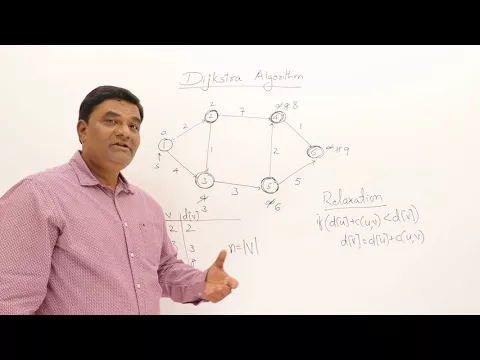
Video Explanation
Interactive Visualization
Below is an interactive visualizer for Dijkstra's algorithm. You can click Start Dijkstra to watch the algorithm explore nodes and update distances using a min-priority queue, or click Next Step to step through the execution manually!
How It Works
The algorithm uses a Min-Priority Queue to continually select the unvisited vertex with the smallest known distance from the source.
Steps
- Initialize the distance to the source node as
0, and all other nodes to∞. - Insert all nodes into a priority queue based on their current distances.
- While the priority queue is not empty:
- Extract the node
uwith the minimum distance. - For each neighbor
vofu:- Calculate the new distance
dist[u] + weight(u, v). - If this new distance is less than the current
dist[v], updatedist[v]and update the priority queue.
- Calculate the new distance
- Extract the node
Complexity Analysis
| Metric | Value |
|---|---|
| Time Complexity | O((V + E) log V) |
| Space Complexity | O(V) |
Where V = number of vertices, E = number of edges. The time complexity assumes the use of a Priority Queue / Min-Heap.
Implementations
Python
import heapq

def dijkstra(graph, start):
    # Initialize distances
    distances = {node: float('inf') for node in graph}
    distances[start] = 0

    # Priority queue stores (distance, node)
    pq = [(0, start)]

    while pq:
        current_distance, current_node = heapq.heappop(pq)

        # Optimization: ignore obsolete entries in the priority queue
        if current_distance > distances[current_node]:
            continue

        for neighbor, weight in graph[current_node].items():
            distance = current_distance + weight

            if distance < distances[neighbor]:
                distances[neighbor] = distance
                heapq.heappush(pq, (distance, neighbor))

    return distances
Java
import java.util.*;

public class Dijkstra {
    static class Node implements Comparable<Node> {
        int vertex, weight;
        Node(int v, int w) { vertex = v; weight = w; }
        public int compareTo(Node other) { return Integer.compare(this.weight, other.weight); }
    }

    public static int[] dijkstra(int V, List<List<Node>> graph, int source) {
        int[] dist = new int[V];
        Arrays.fill(dist, Integer.MAX_VALUE);
        dist[source] = 0;

        PriorityQueue<Node> pq = new PriorityQueue<>();
        pq.add(new Node(source, 0));

        while (!pq.isEmpty()) {
            Node current = pq.poll();
            int u = current.vertex;

            if (current.weight > dist[u]) continue;

            for (Node neighbor : graph.get(u)) {
                int v = neighbor.vertex;
                int weight = neighbor.weight;

                if (dist[u] + weight < dist[v]) {
                    dist[v] = dist[u] + weight;
                    pq.add(new Node(v, dist[v]));
                }
            }
        }
        return dist;
    }
}
C++
#include <iostream>
#include <vector>
#include <queue>

using namespace std;

typedef pair<int, int> pii;

vector<int> dijkstra(int V, vector<vector<pii>>& graph, int source) {
    vector<int> dist(V, 1e9); // 1e9 represents infinity
    dist[source] = 0;

    priority_queue<pii, vector<pii>, greater<pii>> pq;
    pq.push({0, source});

    while (!pq.empty()) {
        int d = pq.top().first;
        int u = pq.top().second;
        pq.pop();

        if (d > dist[u]) continue;

        for (auto edge : graph[u]) {
            int v = edge.first;
            int weight = edge.second;

            if (dist[u] + weight < dist[v]) {
                dist[v] = dist[u] + weight;
                pq.push({dist[v], v});
            }
        }
    }
    return dist;
}
JavaScript
class PriorityQueue {
    constructor() { this.values = []; }
    enqueue(val, priority) {
        this.values.push({val, priority});
    }
    dequeue() {
        let minIdx = 0;
        for (let i = 1; i < this.values.length; i++) {
            if (this.values[i].priority < this.values[minIdx].priority) {
                minIdx = i;
            }
        }
        return this.values.splice(minIdx, 1)[0];
    }
    isEmpty() { return this.values.length === 0; }
}

function dijkstra(graph, start) {
    const distances = {};
    const pq = new PriorityQueue();

    for (let node in graph) {
        distances[node] = Infinity;
    }
    distances[start] = 0;
    pq.enqueue(start, 0);

    while (!pq.isEmpty()) {
        const {val: current_node, priority: current_distance} = pq.dequeue();

        if (current_distance > distances[current_node]) continue;

        for (let neighbor in graph[current_node]) {
            let distance = current_distance + graph[current_node][neighbor];

            if (distance < distances[neighbor]) {
                distances[neighbor] = distance;
                pq.enqueue(neighbor, distance);
            }
        }
    }
    return distances;
}
Real-World Use Cases
- Google Maps — Routing and finding the fastest path between cities or locations.
- Network Routing Protocols — OSPF (Open Shortest Path First) uses Dijkstra's algorithm to compute the shortest path for data packets.
- Video Games — Pathfinding algorithms for NPCs to navigate maps while avoiding obstacles.
Test Your Understanding
Answer these 3 questions to check what you have learned.
What restriction must edge weights satisfy for Dijkstra to give correct results?
Using a binary min-heap, what is the time complexity of Dijkstra?
Dijkstra's algorithm is an example of which paradigm?
Done with this topic? Mark it as complete to track your progress.
Was this page helpful?
Discuss this page
Have a question or spot something confusing in "Dijkstra's Algorithm"? Ask below. Backed by GitHub Discussions—maintainers receive system notifications directly.