Depth-First Search (DFS)
Depth-First Search (DFS) is a graph traversal algorithm that explores as far as possible along each branch before backtracking.
DFS is extremely useful for topological sorting, detecting cycles, and solving mazes or puzzles with a single solution.
Video Explanation
How It Works
DFS uses a Stack (LIFO) data structure, typically implemented via the call stack during recursion, to keep track of the vertices to visit.
Difference from BFS
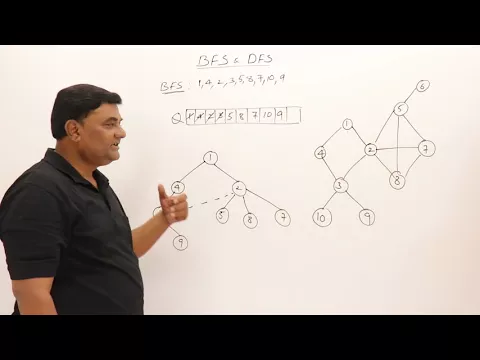
While DFS dives deep into a graph by exploring as far as possible along each branch before backtracking, Breadth-First Search (BFS) explores the graph level by level, visiting all immediate neighbors of a node before moving deeper. BFS uses a Queue (FIFO) data structure, whereas DFS uses a Stack (LIFO).
Steps
- Start by picking a node and marking it as visited.
- Visit an adjacent unvisited node, mark it as visited, and recursively call DFS on it.
- If the current node has no unvisited adjacent nodes, backtrack to the previous node and continue the process.
- The traversal ends when all reachable nodes are visited.
Complexity Analysis
| Metric | Value |
|---|---|
| Time Complexity | O(V + E) |
| Space Complexity | O(V) |
Where V = number of vertices, E = number of edges. Space complexity stems from the recursion stack in the worst-case scenario (e.g., a straight line graph).
Implementations
Python
Recursive Implementation
def dfs(graph, start, visited=None):
    if visited is None:
        visited = set()

    visited.add(start)
    print(start, end=" ")

    for neighbor in graph[start]:
        if neighbor not in visited:
            dfs(graph, neighbor, visited)

# Example graph represented as an adjacency list
graph = {
    0: [1, 2],
    1: [0, 3, 4],
    2: [0, 5],
    3: [1],
    4: [1],
    5: [2]
}
dfs(graph, 0) # Output: 0 1 3 4 2 5
Iterative Implementation
def dfs_iterative(graph, start):
    visited = set()
    stack = [start]

    while stack:
        node = stack.pop()
        if node not in visited:
            print(node, end=" ")
            visited.add(node)
            # Add neighbors to stack in reverse order to visit them in the same order as recursion.
            # Note: This simple iterative approach can push duplicate nodes onto the stack,
            # leading to a worst-case space complexity of O(E) instead of O(V).
            stack.extend(reversed(graph[node]))

dfs_iterative(graph, 0) # Output: 0 1 3 4 2 5
Java
import java.util.*;

public class DFS {
    public static void dfs(List<List<Integer>> graph, int start, boolean[] visited) {
        visited[start] = true;
        System.out.print(start + " ");

        for (int neighbor : graph.get(start)) {
            if (!visited[neighbor]) {
                dfs(graph, neighbor, visited);
            }
        }
    }
}
C++
#include <iostream>
#include <vector>

using namespace std;

void dfs(vector<vector<int>>& graph, int start, vector<bool>& visited) {
    visited[start] = true;
    cout << start << " ";

    for (int neighbor : graph[start]) {
        if (!visited[neighbor]) {
            dfs(graph, neighbor, visited);
        }
    }
}
JavaScript
function dfs(graph, start, visited = new Set()) {
    visited.add(start);
    console.log(start);

    for (const neighbor of graph[start]) {
        if (!visited.has(neighbor)) {
            dfs(graph, neighbor, visited);
        }
    }
}
Real-World Use Cases
- Cycle Detection — Finding cycles in graphs to resolve deadlocks.
- Topological Sorting — Used in build systems (like Make or npm) to resolve dependencies.
- Connected Components — Finding all connected components in an undirected graph.
- Path Finding — Finding a path in games or mazes where we just need any path, not necessarily the shortest.
Test Your Understanding
Answer these 3 questions to check what you have learned.
What data structure underpins recursive DFS?
What is the time complexity of DFS with V vertices and E edges?
DFS is commonly used for:
Done with this topic? Mark it as complete to track your progress.
Was this page helpful?
Discuss this page
Have a question or spot something confusing in "Depth-First Search (DFS)"? Ask below. Backed by GitHub Discussions—maintainers receive system notifications directly.