Introduction to Tarjan's Algorithm
Tarjan's Algorithm for Strongly Connected Components
Overview
Tarjan's Algorithm is an efficient DFS-based algorithm used to find all Strongly Connected Components (SCCs) in a directed graph. A strongly connected component of a directed graph is a maximal subset of vertices where each vertex is reachable from every other vertex in the subset.
Video Explanation

Use Cases
- Optimizing Network Communication: Identifying components in network design where nodes (e.g., servers) can communicate both ways.
- Dependency Analysis: Useful in scenarios where components or modules have dependencies on one another.
- Deadlock Detection: In an operating system, SCCs can be used to identify deadlock cycles in a wait-for graph.
Algorithm Details
Steps
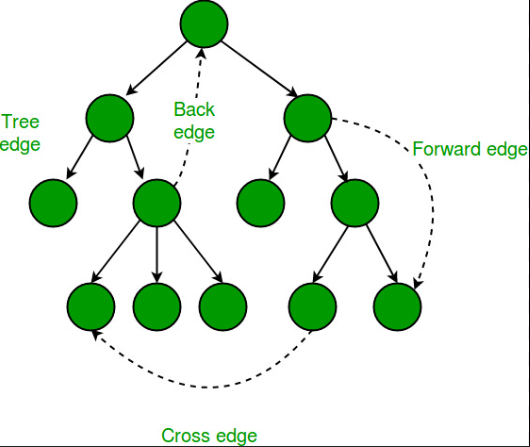
- Perform a Depth First Search (DFS) traversal on the graph.
- Track discovery and low-link values for each node:
- Discovery Time: Order in which a node is visited.
- Low-Link Value: The lowest discovery time reachable from that node.
- Nodes are pushed to a stack upon their initial discovery and are considered part of an SCC until all reachable nodes are processed.
- After visiting all nodes from a given node, if the node is the root of an SCC (where its discovery time equals its low-link value), all nodes in the SCC are popped from the stack.
Time Complexity
- O(V + E) where V is the number of vertices and E is the number of edges. This efficiency arises because each node and edge is visited only once.
Pseudocode
function tarjansSCC(graph):
    Initialize discovery and low arrays to -1
    Initialize an empty stack and set index = 0
    For each vertex v in graph:
        if v is not visited:
            DFS(v)
    end function

function DFS(v):
    Set discovery[v] = low[v] = index; index++
    Push v to the stack
    For each neighbor u of v:
        if u is not visited:
            DFS(u)
            Set low[v] = min(low[v], low[u])
        else if u is in the stack:
            Set low[v] = min(low[v], discovery[u])
    end loop

    if discovery[v] == low[v]:
        While stack top is not v:
            Pop vertex from stack and add to current SCC
        Add v to SCC
    end if
end function
Example Code in C++
Here’s a C++ implementation of Tarjan's Algorithm:
#include <iostream>
#include <vector>
#include <stack>
using namespace std;

class TarjansAlgorithm {
private:
    vector<vector<int>> adj;
    vector<int> discovery, low;
    stack<int> stk;
    vector<bool> onStack;
    int time = 0, V;

    void DFS(int v) {
        discovery[v] = low[v] = ++time;
        stk.push(v);
        onStack[v] = true;

        for (int u : adj[v]) {
            if (discovery[u] == -1) {  // u is not visited
                DFS(u);
                low[v] = min(low[v], low[u]);
            } else if (onStack[u]) {
                low[v] = min(low[v], discovery[u]);
            }
        }

        if (discovery[v] == low[v]) {
            cout << "SCC: ";
            while (true) {
                int u = stk.top(); stk.pop();
                onStack[u] = false;
                cout << u << " ";
                if (u == v) break;
            }
            cout << endl;
        }
    }

public:
    TarjansAlgorithm(int vertices) : V(vertices), adj(vertices), discovery(vertices, -1), low(vertices, -1), onStack(vertices, false) {}

    void addEdge(int v, int u) {
        adj[v].push_back(u);
    }

    void findSCCs() {
        for (int i = 0; i < V; ++i)
            if (discovery[i] == -1)
                DFS(i);
    }
};

int main() {
    TarjansAlgorithm g(5);
    g.addEdge(1, 0);
    g.addEdge(0, 2);
    g.addEdge(2, 1);
    g.addEdge(0, 3);
    g.addEdge(3, 4);
    cout << "Strongly Connected Components:\n";
    g.findSCCs();
    return 0;
}
Explanation of the Code
- DFS Traversal: The code initiates a DFS for each unvisited node, updating discovery and low values.
- Stack Operations: Nodes are added to the stack when first visited. If a node completes processing and is the root of an SCC, nodes are popped from the stack until the root node is reached.
- Printing SCCs: When an SCC is identified (where discovery[v] == low[v]), the SCC is printed.
Example Walkthrough
Consider a graph with vertices and edges as shown:
- Vertices are visited according to their DFS discovery time.
- Each SCC is printed as it's identified when discovery == low for that root node.
Diagram of SCCs
Below is an example directed graph that Tarjan’s Algorithm would traverse:
- Nodes: 0, 1, 2, 3, 4
- Edges: 1 -> 0, 0 -> 2, 2 -> 1, 0 -> 3, 3 -> 4
For this graph, SCCs are:
- SCC 1: 2
- SCC 2: 3
- SCC 3: 4
Real-World Example
Consider using Tarjan's Algorithm in a call graph of a large software application to identify isolated functional units. Each SCC in this call graph could represent a module that can operate independently or an area where cyclic dependencies might be managed.
Done with this topic? Mark it as complete to track your progress.
Was this page helpful?
Discuss this page
Have a question or spot something confusing in "Introduction to Tarjan's Algorithm"? Ask below. Backed by GitHub Discussions—maintainers receive system notifications directly.