Constructors and Destructors in OOP
Constructors and Destructors
Constructors and destructors are special member functions in object-oriented programming (OOP) that are automatically called when an object is created or destroyed, respectively. They are essential for initializing and cleaning up resources used by objects.
Video Explanation
1. What is a Constructor?
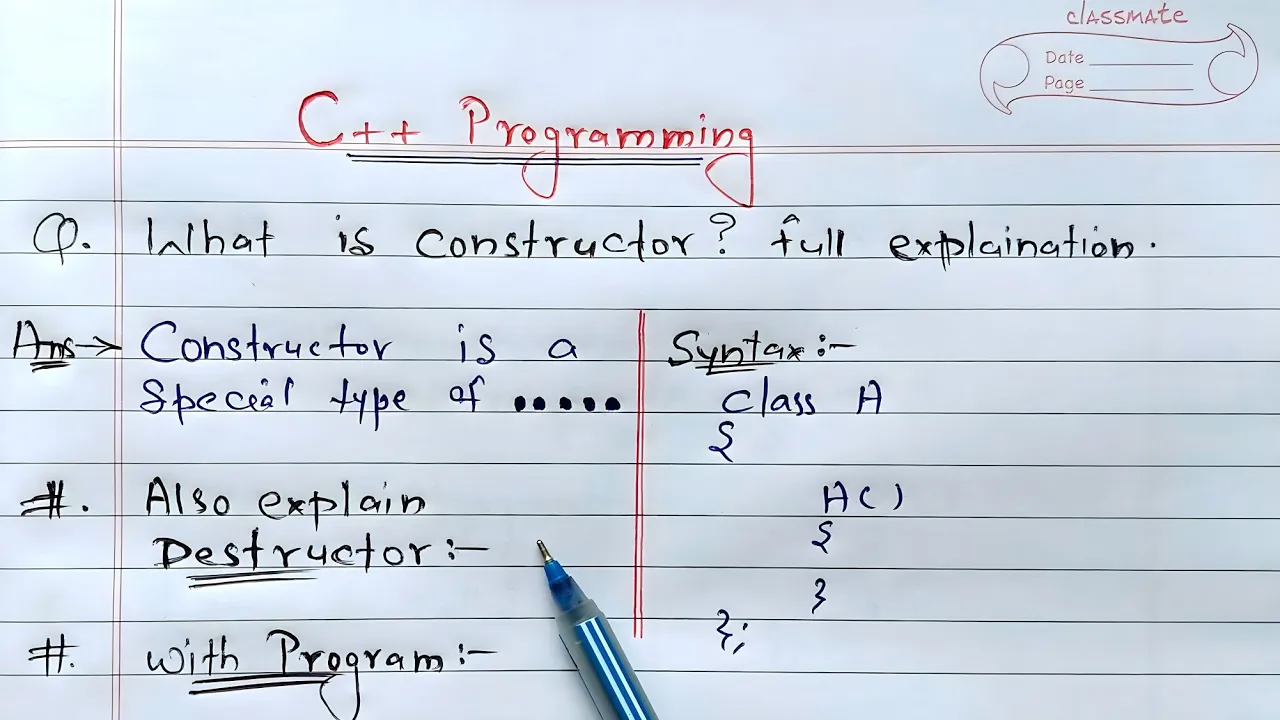
A constructor is a special function that initializes an object when it is created. It has the same name as the class and does not have a return type. Constructors can take parameters to initialize object attributes.
Types of Constructors
- Default Constructor: A constructor that does not take any parameters.
- Parameterized Constructor: A constructor that takes parameters to set initial values for the object.
Example of Constructors
C++ Code
#include <iostream>
using namespace std;

class Rectangle {
private:
    int width, height;

public:
    // Default Constructor
    Rectangle() {
        width = 0;
        height = 0;
    }

    // Parameterized Constructor
    Rectangle(int w, int h) {
        width = w;
        height = h;
    }

    void display() {
        cout << "Width: " << width << ", Height: " << height << endl;
    }
};

int main() {
    Rectangle rect1; // Default constructor
    Rectangle rect2(10, 5); // Parameterized constructor

    rect1.display();
    rect2.display();
    return 0;
}
Java Code
class Rectangle {
    private int width, height;

    // Default Constructor
    Rectangle() {
        width = 0;
        height = 0;
    }

    // Parameterized Constructor
    Rectangle(int w, int h) {
        width = w;
        height = h;
    }

    void display() {
        System.out.println("Width: " + width + ", Height: " + height);
    }
}

public class Main {
    public static void main(String[] args) {
        Rectangle rect1 = new Rectangle(); // Default constructor
        Rectangle rect2 = new Rectangle(10, 5); // Parameterized constructor

        rect1.display();
        rect2.display();
    }
}
2. What is a Destructor?
A destructor is a special function that is called when an object is destroyed. It has the same name as the class but is preceded by a tilde (~) in C++. Destructors are used to release resources allocated to the object, such as memory or file handles.
Example of Destructors
C++ Code
#include <iostream>
using namespace std;

class Rectangle {
private:
    int width, height;

public:
    Rectangle(int w, int h) : width(w), height(h) {
        cout << "Constructor called!" << endl;
    }

    ~Rectangle() {
        cout << "Destructor called!" << endl;
    }

    void display() {
        cout << "Width: " << width << ", Height: " << height << endl;
    }
};

int main() {
    Rectangle rect(10, 5);
    rect.display();
    return 0; // Destructor is called automatically here
}
Java Code
class Rectangle {
    private int width, height;

    Rectangle(int w, int h) {
        width = w;
        height = h;
        System.out.println("Constructor called!");
    }

    // Finalize method acts as a destructor in Java
    protected void finalize() {
        System.out.println("Destructor called!");
    }

    void display() {
        System.out.println("Width: " + width + ", Height: " + height);
    }
}

public class Main {
    public static void main(String[] args) {
        Rectangle rect = new Rectangle(10, 5);
        rect.display();
        rect = null; // Request garbage collection
        System.gc(); // Calling garbage collector
    }
}
3. Importance of Constructors and Destructors
- Resource Management: Constructors are used to allocate resources, while destructors are used to release them. This ensures that resources are properly managed and prevents memory leaks.
- Initialization: Constructors allow for setting initial values for object attributes, providing a clear and consistent way to create objects.
Done with this topic? Mark it as complete to track your progress.
Was this page helpful?
Discuss this page
Have a question or spot something confusing in "Constructors and Destructors in OOP"? Ask below. Backed by GitHub Discussions—maintainers receive system notifications directly.