Prefix Sum Algorithm
Prefix Sum Algorithm
Introduction & Intuition
Imagine you are given an array of n numbers and asked hundreds of thousands of times: "What is the sum of elements from index l to index r?"
A naive approach would loop through arr[l..r] for every query — costing O(n) per query, or O(n × Q) total (where Q is the number of queries). For large inputs, this is too slow.
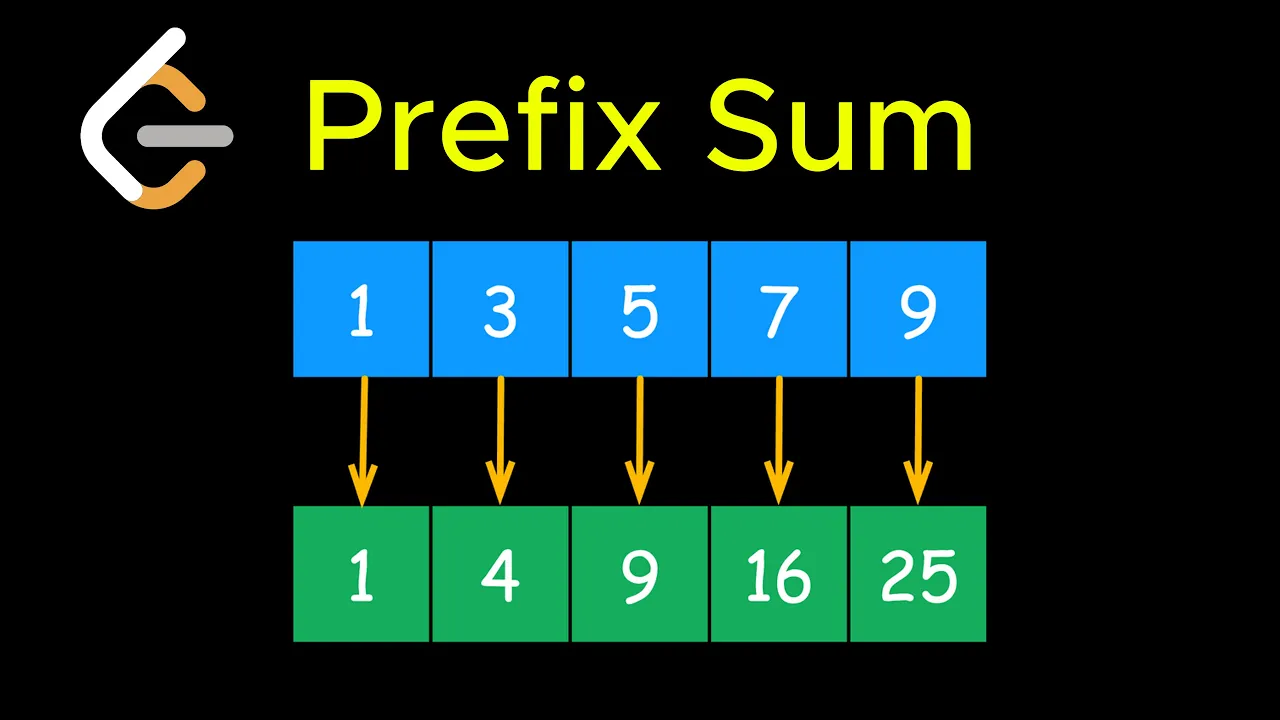
Prefix Sum solves this with a simple preprocessing trick:
Build an auxiliary array
prefix[]whereprefix[i]stores the sum of all elements from index 0 to i.
Then, any range sum arr[l..r] can be answered in O(1) using:
rangeSum(l, r) = prefix[r] - prefix[l - 1]
This is the core idea: precompute cumulative sums once, then answer each query in constant time.
Video Explanation
Building the Prefix Sum Array
Given an array:
arr = [3, 1, 4, 1, 5, 9, 2, 6]
The prefix sum array is built as:
prefix[0] = arr[0]            = 3
prefix[1] = prefix[0] + arr[1] = 3 + 1 = 4
prefix[2] = prefix[1] + arr[2] = 4 + 4 = 8
prefix[3] = prefix[2] + arr[3] = 8 + 1 = 9
prefix[4] = prefix[3] + arr[4] = 9 + 5 = 14
prefix[5] = prefix[4] + arr[5] = 14 + 9 = 23
prefix[6] = prefix[5] + arr[6] = 23 + 2 = 25
prefix[7] = prefix[6] + arr[7] = 25 + 6 = 31
So:
prefix = [3, 4, 8, 9, 14, 23, 25, 31]
Range Sum Query — Dry Run
Query: Sum of arr[2..5] → expected = 4 + 1 + 5 + 9 = 19
Using the formula:
rangeSum(2, 5) = prefix[5] - prefix[1]
              = 23 - 4
              = 19  ✓
Query: Sum of arr[0..4] → expected = 3 + 1 + 4 + 1 + 5 = 14
rangeSum(0, 4) = prefix[4] - prefix[-1]
              = 14 - 0          (prefix[-1] is defined as 0)
              = 14  ✓
Tip: Use a 1-indexed prefix array (
prefix[1..n]) to avoid the special case forl = 0.
Formula (1-indexed version)
If prefix[i] = arr[1] + arr[2] + ... + arr[i], then:
rangeSum(l, r) = prefix[r] - prefix[l - 1]
This is uniform for all l, including l = 1.
Time & Space Complexity
| Operation | Complexity |
|---|---|
| Build prefix array | O(n) |
| Single range query | O(1) |
| Total for Q queries | O(n + Q) |
| Space (prefix array) | O(n) |
Common Mistakes
- Off-by-one errors — confusing 0-indexed vs 1-indexed. Always decide upfront and be consistent.
- Forgetting
prefix[-1] = 0— when using 0-indexed andl = 0, you must handle this edge case. - Modifying the original array — don't overwrite
arr[]while buildingprefix[]. - Integer overflow — for large arrays with large values, use
long longin C++ orlongin Java. - Not re-building on updates — prefix sum is static; for dynamic updates, consider a Fenwick Tree or Segment Tree.
C++ Implementation
#include <iostream>
#include <vector>
using namespace std;

int main() {
    vector<int> arr = {3, 1, 4, 1, 5, 9, 2, 6};
    int n = arr.size();

    // Build prefix sum array (1-indexed for simplicity)
    vector<long long> prefix(n + 1, 0);
    for (int i = 1; i <= n; i++) {
        prefix[i] = prefix[i - 1] + arr[i - 1];
    }

    // Range sum query: sum of arr[l..r] (1-indexed)
    auto rangeSum = [&](int l, int r) -> long long {
        return prefix[r] - prefix[l - 1];
    };

    // Example queries
    cout << "Sum of arr[1..4] = " << rangeSum(1, 4) << endl;  // 3+1+4+1 = 9
    cout << "Sum of arr[3..6] = " << rangeSum(3, 6) << endl;  // 4+1+5+9 = 19
    cout << "Sum of arr[1..8] = " << rangeSum(1, 8) << endl;  // 31

    return 0;
}
Output:
Sum of arr[1..4] = 9
Sum of arr[3..6] = 19
Sum of arr[1..8] = 31
Java Implementation
public class PrefixSum {

    static long[] buildPrefix(int[] arr) {
        if (arr == null) {
            return new long[1];
        }
        int n = arr.length;
        long[] prefix = new long[n + 1]; // 1-indexed
        for (int i = 1; i <= n; i++) {
            prefix[i] = prefix[i - 1] + arr[i - 1];
        }
        return prefix;
    }

    static long rangeSum(long[] prefix, int l, int r) {
        return prefix[r] - prefix[l - 1];
    }

    public static void main(String[] args) {
        int[] arr = {3, 1, 4, 1, 5, 9, 2, 6};
        long[] prefix = buildPrefix(arr);

        System.out.println("Sum of arr[1..4] = " + rangeSum(prefix, 1, 4)); // 9
        System.out.println("Sum of arr[3..6] = " + rangeSum(prefix, 3, 6)); // 19
        System.out.println("Sum of arr[1..8] = " + rangeSum(prefix, 1, 8)); // 31
    }
}
Python Implementation
def build_prefix(arr):
    if arr is None:
        return [0]
    n = len(arr)
    prefix = [0] * (n + 1)  # 1-indexed
    for i in range(1, n + 1):
        prefix[i] = prefix[i - 1] + arr[i - 1]
    return prefix

def range_sum(prefix, l, r):
    """Returns sum of arr[l..r] (1-indexed)."""
    return prefix[r] - prefix[l - 1]

# Example usage
arr = [3, 1, 4, 1, 5, 9, 2, 6]
prefix = build_prefix(arr)

print(f"Sum of arr[1..4] = {range_sum(prefix, 1, 4)}")  # 9
print(f"Sum of arr[3..6] = {range_sum(prefix, 3, 6)}")  # 19
print(f"Sum of arr[1..8] = {range_sum(prefix, 1, 8)}")  # 31
JavaScript Implementation
function buildPrefix(arr) {
    if (!arr) {
        return [0];
    }
    const n = arr.length;
    const prefix = new Array(n + 1).fill(0); // 1-indexed
    for (let i = 1; i <= n; i++) {
        prefix[i] = prefix[i - 1] + arr[i - 1];
    }
    return prefix;
}

function rangeSum(prefix, l, r) {
    return prefix[r] - prefix[l - 1];
}

// Example usage
const arr = [3, 1, 4, 1, 5, 9, 2, 6];
const prefix = buildPrefix(arr);

console.log(`Sum of arr[1..4] = ${rangeSum(prefix, 1, 4)}`); // 9
console.log(`Sum of arr[3..6] = ${rangeSum(prefix, 3, 6)}`); // 19
console.log(`Sum of arr[1..8] = ${rangeSum(prefix, 1, 8)}`); // 31
Competitive Programming Applications
| Problem Type | How Prefix Sum Helps |
|---|---|
| Range Sum Query | Direct application — O(1) per query |
| Subarray with Target Sum | Check if prefix[r] - prefix[l] == target |
| Count of Odd/Even numbers in range | Use prefix counts instead of sums |
| Equilibrium Index | Left sum = total - left sum - arr[i] |
| Maximum Subarray Sum (Kadane's variant) | Track min prefix seen so far |
| Counting Inversions | Combined with merge sort |
| Number of subarrays with given XOR | Replace + with XOR in prefix array |
Equilibrium Index — Classic Prefix Sum Problem
An equilibrium index is an index i where the sum of elements to the left equals the sum to the right.
def find_equilibrium(arr):
    total = sum(arr)
    left_sum = 0
    for i, val in enumerate(arr):
        # right_sum = total - left_sum - arr[i]
        if left_sum == total - left_sum - val:
            return i
        left_sum += val
    return -1

arr = [1, 7, 3, 6, 5, 6]
print(f"Equilibrium index: {find_equilibrium(arr)}")  # Output: 3
Summary
- Prefix Sum preprocesses an array in O(n) to answer range sum queries in O(1).
- It's one of the most frequently used techniques in competitive programming.
- Use 1-indexed prefix arrays to avoid edge-case handling for
l = 0. - For large values, watch for integer overflow — use 64-bit integers.
- Prefix Sum is the foundation for more advanced structures like Fenwick Trees and 2D Prefix Sum.
Done with this topic? Mark it as complete to track your progress.
Was this page helpful?
Discuss this page
Have a question or spot something confusing in "Prefix Sum Algorithm"? Ask below. Backed by GitHub Discussions—maintainers receive system notifications directly.