Classes and Objects in OOP
Classes and Objects in Object-Oriented Programming
In Object-Oriented Programming (OOP), classes and objects are fundamental concepts that help structure your code.
Video Explanation

What is a Class?
A class is a blueprint or template for creating objects. It defines a datatype by bundling data and methods that work on the data. Classes encapsulate data for the object and define methods for manipulating that data.
Key Components of a Class:
- Attributes: Variables that hold data for the class.
- Methods: Functions defined inside the class that can manipulate the attributes.
Example of a Class
C++ Code
class Car {
private:
    string model;
    int year;

public:
    // Constructor
    Car(string m, int y) : model(m), year(y) {}

    // Method to display car details
    void display() {
        cout << "Model: " << model << ", Year: " << year << endl;
    }
};
Java Code
class Car {
    private String model;
    private int year;

    // Constructor
    Car(String m, int y) {
        model = m;
        year = y;
    }

    // Method to display car details
    void display() {
        System.out.println("Model: " + model + ", Year: " + year);
    }
}
What is an Object?
An object is an instance of a class. When you create an object, you create a specific instance of a class with its own unique set of attributes. Objects interact with one another and can have their own state and behavior.
Creating Objects
C++ Code
int main() {
    Car myCar("Toyota", 2020);
    myCar.display(); // Output: Model: Toyota, Year: 2020
    return 0;
}
Java Code
public class Main {
    public static void main(String[] args) {
        Car myCar = new Car("Toyota", 2020);
        myCar.display(); // Output: Model: Toyota, Year: 2020
    }
}
Key Differences Between Classes and Objects:
- Definition: A class is a blueprint; an object is an instance of that blueprint.
- Memory: Class is a logical entity; an object is a physical entity in memory.
- Instantiation: Classes need to be instantiated to create objects.
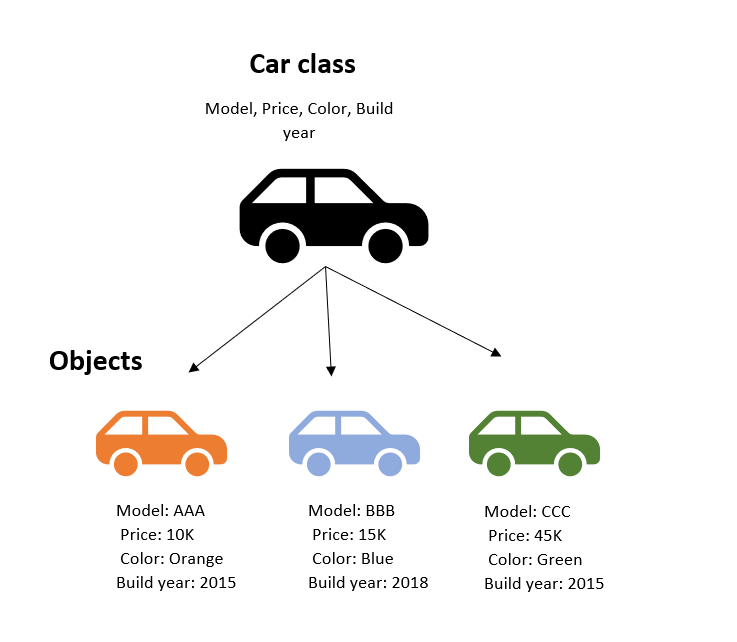
Diagram illustrating the relationship between classes and objects in OOP.
Conclusion
Classes and objects are the cornerstones of OOP, enabling developers to create modular, reusable, and maintainable code. Understanding these concepts is essential for mastering object-oriented design and programming.
Done with this topic? Mark it as complete to track your progress.
Was this page helpful?
Discuss this page
Have a question or spot something confusing in "Classes and Objects in OOP"? Ask below. Backed by GitHub Discussions—maintainers receive system notifications directly.