Arguments vs. Parameters
1. Introduction
Although the terms parameter and argument are often used interchangeably in casual developer conversation, they have distinct meanings in computer science and programming.
- A parameter is the variable defined in the function's signature. It acts as a placeholder.
- An argument is the actual value or expression passed to the function when it is called.
2. Definitions and Visualizing the Difference
// FUNCTION DEFINITION (Declaration)
function add(num1, num2) {   <--- num1 and num2 are PARAMETERS (placeholders)
  return num1 + num2;
}

// FUNCTION INVOCATION (Call)
add(5, 10);                  <--- 5 and 10 are ARGUMENTS (actual values)
2.1 Parameters (Formal Parameters)
- Defined inside the parentheses of the function definition.
- Define what kind of data the function expects.
- Behave like local variables initialized inside the function scope.
2.2 Arguments (Actual Parameters)
- Provided inside the parentheses when calling/invoking the function.
- Represent the actual data that will be assigned to the parameters.
- Can be literals (e.g.
5,"hello"), variables (e.g.x), or complex expressions (e.g.y * 2 + z).
3. Side-by-Side Comparison
| Feature | Parameter | Argument |
|---|---|---|
| Synonyms | Formal Parameter, Formal Argument | Actual Parameter, Actual Argument |
| Location | Defined in the function declaration/signature | Passed in the function call/invocation |
| Purpose | Specifies the interface and imports data into the local scope | Supplies the specific values/references for processing |
| Lifecycle | Exists for the duration of the function call | Exists before the function call, evaluated before passing |
| Changeability | Stays constant in code structure | Varies with each function invocation |
4. Advanced Concepts
4.1 Function Arity
Arity is the number of parameters a function expects.
- Nullary: 0 parameters (e.g.,
greet()) - Unary: 1 parameter (e.g.,
square(x)) - Binary: 2 parameters (e.g.,
add(x, y)) - Variadic: Accepts a variable number of arguments.
4.2 Handling Variadic Arguments
When the number of arguments supplied exceeds or varies from the number of parameters, different languages handle them in various ways:
A. JavaScript (Rest Parameters)
JavaScript allows you to gather all remaining arguments into a single array parameter using the rest operator (...).
// 'numbers' is a rest parameter, collecting all arguments into an array
function sumAll(...numbers) {
  return numbers.reduce((acc, curr) => acc + curr, 0);
}

// 5 arguments are passed
console.log(sumAll(1, 2, 3, 4, 5)); // Output: 15
B. Python (*args and **kwargs)
Python uses *args to collect extra positional arguments as a tuple, and **kwargs to collect extra keyword arguments as a dictionary.
def print_details(*args, **kwargs):
    print("Positional arguments:", args)
    print("Keyword arguments:", kwargs)

print_details(1, 2, 3, name="Bob", age=30)
# Output:
# Positional arguments: (1, 2, 3)
# Keyword arguments: {'name': 'Bob', 'age': 30}
C. C++ (Variadic Templates)
Modern C++ uses variadic templates to accept any number of arguments of any types safely.
#include <iostream>

// Base case
void print() {
    std::cout << std::endl;
}

// Recursive variadic template function
template<typename T, typename... Args>
void print(T first, Args... args) {
    std::cout << first << " ";
    print(args...);
}

int main() {
    print(1, 2.5, "hello", 'C'); // Output: 1 2.5 hello C
    return 0;
}
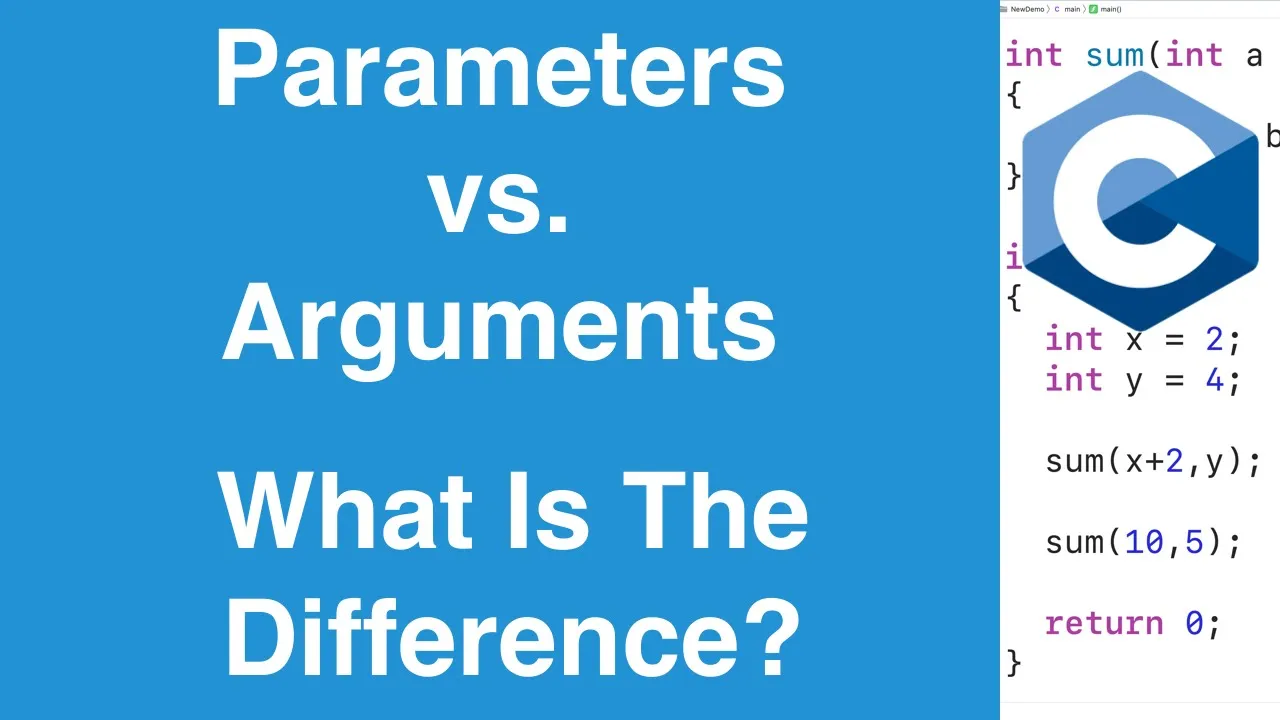
5. Video Explanation
Done with this topic? Mark it as complete to track your progress.
Was this page helpful?
Discuss this page
Have a question or spot something confusing in "Arguments vs. Parameters"? Ask below. Backed by GitHub Discussions—maintainers receive system notifications directly.