N-Queens
Description:
The n-queens puzzle is the problem of placing n queens on an n x n chessboard such that no two queens attack each other.
Given an integer n, return all distinct solutions to the n-queens puzzle. You may return the answer in any order.
Each solution contains a distinct board configuration of the n-queens' placement, where 'Q' and '.' both indicate a queen and an empty space, respectively.
Example 1:
Input: n = 4
Output: [[".Q..","...Q","Q...","..Q."],["..Q.","Q...","...Q",".Q.."]]
Explanation: There exist two distinct solutions to the 4-queens puzzle as shown above.
Example 2:
Input: n = 1
Output: [["Q"]]
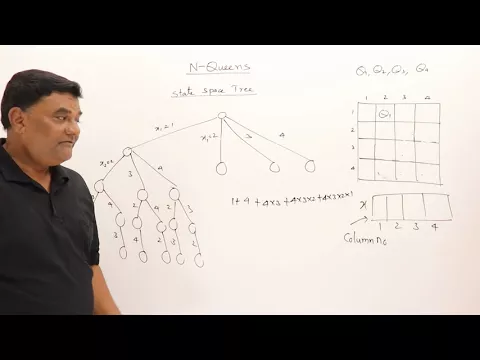
Video Explanation
Approaches:
1. Backtracking
The most effective way to solve the N-Queens problem is using Backtracking. We place queens row by row. For each row, we try to place a queen in each column. We must ensure that the new queen is not under attack by any previously placed queens.
- Maintain three sets to track the columns and the two diagonals (positive and negative) that are currently occupied by queens.
- The positive diagonal has a constant property where
row + colis the same for all elements on that diagonal. - The negative diagonal has a constant property where
row - colis the same for all elements on that diagonal. - Create a recursive
backtrackfunction that starts atrow = 0. - If
row == n, a valid board configuration has been found, so we format it and add it to our results. - For the current row, iterate through each column
c. If placing a queen at(row, c)violates any of our sets, skip it. - Otherwise, place the queen, update the sets, and recursively call
backtrack(row + 1). - After exploring that path, remove the queen and back out of the sets to explore other possibilities.
- Time Complexity: where is the number of queens. For the first row we have choices, for the next roughly , and so on, leading to a factorial time complexity.
- Space Complexity: for storing the board state and the output array, plus for the recursion stack and the sets used to track attacks.
Solutions
- C++
- Java
- Python
- JavaScript
class Solution {
public:
    vector<vector<string>> solveNQueens(int n) {
        vector<vector<string>> res;
        vector<string> board(n, string(n, '.'));
        vector<int> col(n, 0), posDiag(2 * n, 0), negDiag(2 * n, 0);
        backtrack(0, n, board, res, col, posDiag, negDiag);
        return res;
    }

private:
    void backtrack(int r, int n, vector<string>& board, vector<vector<string>>& res, vector<int>& col, vector<int>& posDiag, vector<int>& negDiag) {
        if (r == n) {
            res.push_back(board);
            return;
        }
        for (int c = 0; c < n; c++) {
            if (col[c] || posDiag[r + c] || negDiag[r - c + n]) continue;

            board[r][c] = 'Q';
            col[c] = posDiag[r + c] = negDiag[r - c + n] = 1;

            backtrack(r + 1, n, board, res, col, posDiag, negDiag);

            board[r][c] = '.';
            col[c] = posDiag[r + c] = negDiag[r - c + n] = 0;
        }
    }
};
class Solution {
    public List<List<String>> solveNQueens(int n) {
        List<List<String>> res = new ArrayList<>();
        char[][] board = new char[n][n];
        for (int i = 0; i < n; i++) {
            Arrays.fill(board[i], '.');
        }

        Set<Integer> col = new HashSet<>();
        Set<Integer> posDiag = new HashSet<>();
        Set<Integer> negDiag = new HashSet<>();

        backtrack(0, n, board, res, col, posDiag, negDiag);
        return res;
    }

    private void backtrack(int r, int n, char[][] board, List<List<String>> res, Set<Integer> col, Set<Integer> posDiag, Set<Integer> negDiag) {
        if (r == n) {
            List<String> copy = new ArrayList<>();
            for (char[] row : board) {
                copy.add(new String(row));
            }
            res.add(copy);
            return;
        }

        for (int c = 0; c < n; c++) {
            if (col.contains(c) || posDiag.contains(r + c) || negDiag.contains(r - c)) {
                continue;
            }

            col.add(c);
            posDiag.add(r + c);
            negDiag.add(r - c);
            board[r][c] = 'Q';

            backtrack(r + 1, n, board, res, col, posDiag, negDiag);

            col.remove(c);
            posDiag.remove(r + c);
            negDiag.remove(r - c);
            board[r][c] = '.';
        }
    }
}
class Solution:
    def solveNQueens(self, n: int) -> List[List[str]]:
        col = set()
        posDiag = set() # (r + c)
        negDiag = set() # (r - c)

        res = []
        board = [["."] * n for _ in range(n)]

        def backtrack(r):
            if r == n:
                copy = ["".join(row) for row in board]
                res.append(copy)
                return

            for c in range(n):
                if c in col or (r + c) in posDiag or (r - c) in negDiag:
                    continue

                col.add(c)
                posDiag.add(r + c)
                negDiag.add(r - c)
                board[r][c] = "Q"

                backtrack(r + 1)

                col.remove(c)
                posDiag.remove(r + c)
                negDiag.remove(r - c)
                board[r][c] = "."

        backtrack(0)
        return res
/**
 * @param {number} n
 * @return {string[][]}
 */
const solveNQueens = function(n) {
    const res = [];
    const board = Array.from({ length: n }, () => Array(n).fill('.'));
    const col = new Set();
    const posDiag = new Set();
    const negDiag = new Set();

    const backtrack = (r) => {
        if (r === n) {
            res.push(board.map(row => row.join('')));
            return;
        }

        for (let c = 0; c < n; c++) {
            if (col.has(c) || posDiag.has(r + c) || negDiag.has(r - c)) {
                continue;
            }

            col.add(c);
            posDiag.add(r + c);
            negDiag.add(r - c);
            board[r][c] = 'Q';

            backtrack(r + 1);

            col.delete(c);
            posDiag.delete(r + c);
            negDiag.delete(r - c);
            board[r][c] = '.';
        }
    };

    backtrack(0);
    return res;
};
Done with this topic? Mark it as complete to track your progress.
Related Practice Problems
Handpicked problems sharing similar algorithmic topic tags
Combination Sum
Solving the Combination Sum problem using a recursive backtracking approach.
Word Search
Solving the Word Search problem using recursive backtracking and Depth-First Search (DFS).
Largest Rectangle in Histogram
Finding the area of the largest rectangle in a histogram using a monotonic stack approach.
Was this page helpful?
Discuss this page
Have a question or spot something confusing in "N-Queens"? Ask below. Backed by GitHub Discussions—maintainers receive system notifications directly.