Floyd-Warshall Algorithm
The Floyd-Warshall Algorithm is used to find the shortest paths between all pairs of vertices in a weighted graph.
Unlike Dijkstra or Bellman-Ford, which are Single-Source Shortest Path algorithms (finding distances from one node to all others), Floyd-Warshall computes the distances between every node u and every node v.
Floyd-Warshall handles negative weights correctly. It can also be used to detect negative weight cycles (if the distance from a node to itself becomes negative).
Video Explanation
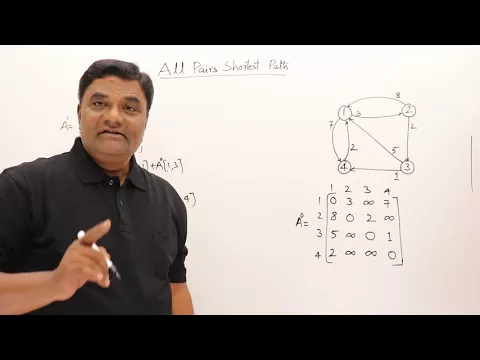
Interactive Visualization
Below is an interactive visualizer for the Floyd-Warshall algorithm. You can click Start Floyd-Warshall to step through the dynamic programming transitions, updating the distance matrix as each intermediate vertex k is considered.
How It Works
The algorithm uses Dynamic Programming. The core idea is to gradually allow more intermediate vertices to form paths between any two nodes.
Steps
- Initialize a 2D
distmatrix. If there's an edge fromutov,dist[u][v] = weight(u, v). Otherwise,dist[u][v] = ∞. The diagonaldist[i][i] = 0. - For each intermediate node
kfrom0toV-1:- For every pair
(i, j):- Check if the path
i → k → jis shorter than the currently known pathi → j. - Update:
dist[i][j] = min(dist[i][j], dist[i][k] + dist[k][j])
- Check if the path
- For every pair
Dry Run Example
Consider the following graph:
Initial Distance Matrix:
| A | B | C | D | |
|---|---|---|---|---|
| A | 0 | 5 | ∞ | 10 |
| B | ∞ | 0 | 3 | ∞ |
| C | ∞ | ∞ | 0 | 1 |
| D | ∞ | ∞ | ∞ | 0 |
The algorithm now considers each vertex as an intermediate node and updates the matrix whenever a shorter path is found.
Unlike Dijkstra's Algorithm, Floyd-Warshall computes shortest paths between every pair of vertices simultaneously by gradually allowing more intermediate vertices.
Matrix Updates
After considering B as intermediate vertex
Path A → B → C gives:
5 + 3 = 8
Updated matrix:
| A | B | C | D | |
|---|---|---|---|---|
| A | 0 | 5 | 8 | 10 |
| B | ∞ | 0 | 3 | ∞ |
| C | ∞ | ∞ | 0 | 1 |
| D | ∞ | ∞ | ∞ | 0 |
After considering C as intermediate vertex
Path A → C → D gives:
8 + 1 = 9
Final Shortest Path Matrix
| A | B | C | D | |
|---|---|---|---|---|
| A | 0 | 5 | 8 | 9 |
| B | ∞ | 0 | 3 | 4 |
| C | ∞ | ∞ | 0 | 1 |
| D | ∞ | ∞ | ∞ | 0 |
The matrix now contains the shortest distances between every pair of vertices after considering all intermediate vertices.
Visualization
Negative Cycle Detection
One advantage of the Floyd-Warshall Algorithm is its ability to detect negative weight cycles.
A negative cycle is a cycle whose total edge weight is negative. If such a cycle exists, the shortest path is undefined because repeatedly traversing the cycle keeps reducing the path cost.
How Detection Works
After all vertices have been considered as intermediate vertices, inspect the diagonal elements of the distance matrix.
For every vertex i:
dist[i][i] < 0
indicates that a path exists from the vertex back to itself with a negative total cost.
Therefore, if any diagonal entry becomes negative, the graph contains a negative weight cycle.
Example
Final distance matrix:
| A | B | |
|---|---|---|
| A | -2 | 1 |
| B | 3 | 0 |
Here:
dist[A][A] = -2
Since the distance from A back to itself is negative, a negative cycle exists in the graph.
If a negative weight cycle is present, the shortest path values are not reliable because the path cost can be reduced indefinitely by repeatedly traversing the cycle.
Detection Check
Pseudo-code:
for i = 0 to V-1:
    if dist[i][i] < 0:
        Negative Cycle Exists
This check takes only O(V) time after the Floyd-Warshall computation is complete.
Complexity Analysis
| Metric | Value |
|---|---|
| Time Complexity | O(V³) |
| Space Complexity | O(V²) |
Where V = number of vertices. Because of the O(V³) time complexity, it is best suited for small, dense graphs.
Implementations
Python
def floyd_warshall(graph):
    V = len(graph)
    dist = list(map(lambda i: list(map(lambda j: j, i)), graph))

    # Adding vertices individually
    for k in range(V):
        for i in range(V):
            for j in range(V):
                dist[i][j] = min(dist[i][j], dist[i][k] + dist[k][j])

    return dist

# Example usage (INF represented as float('inf'))
INF = float('inf')
graph = [
    [0, 5, INF, 10],
    [INF, 0, 3, INF],
    [INF, INF, 0, 1],
    [INF, INF, INF, 0]
]
result = floyd_warshall(graph)
Java
public class FloydWarshall {
    final static int INF = 99999, V = 4;

    void floydWarshall(int graph[][]) {
        int dist[][] = new int[V][V];
        int i, j, k;

        for (i = 0; i < V; i++)
            for (j = 0; j < V; j++)
                dist[i][j] = graph[i][j];

        for (k = 0; k < V; k++) {
            for (i = 0; i < V; i++) {
                for (j = 0; j < V; j++) {
                    if (dist[i][k] + dist[k][j] < dist[i][j])
                        dist[i][j] = dist[i][k] + dist[k][j];
                }
            }
        }
    }
}
C++
#include <iostream>
#include <vector>

using namespace std;
#define INF 99999

void floydWarshall(int V, vector<vector<int>>& graph) {
    vector<vector<int>> dist = graph;

    for (int k = 0; k < V; k++) {
        for (int i = 0; i < V; i++) {
            for (int j = 0; j < V; j++) {
                if (dist[i][k] != INF && dist[k][j] != INF && dist[i][k] + dist[k][j] < dist[i][j]) {
                    dist[i][j] = dist[i][k] + dist[k][j];
                }
            }
        }
    }
}
JavaScript
function floydWarshall(graph) {
    const V = graph.length;
    const dist = Array.from(graph, row => [...row]);

    for (let k = 0; k < V; k++) {
        for (let i = 0; i < V; i++) {
            for (let j = 0; j < V; j++) {
                if (dist[i][k] + dist[k][j] < dist[i][j]) {
                    dist[i][j] = dist[i][k] + dist[k][j];
                }
            }
        }
    }
    return dist;
}
Real-World Use Cases
- Flight Routes — Finding the cheapest connections between all possible city pairs.
- Transitive Closure — Checking if there exists a path between every pair of nodes in a directed graph.
- Network Routing — Used in decentralized networks to update routing tables.
Test Your Understanding
Answer these 3 questions to check what you have learned.
What does Floyd-Warshall compute?
What is the time complexity of Floyd-Warshall?
How does Floyd-Warshall detect negative cycles?
Done with this topic? Mark it as complete to track your progress.
Was this page helpful?
Discuss this page
Have a question or spot something confusing in "Floyd-Warshall Algorithm"? Ask below. Backed by GitHub Discussions—maintainers receive system notifications directly.